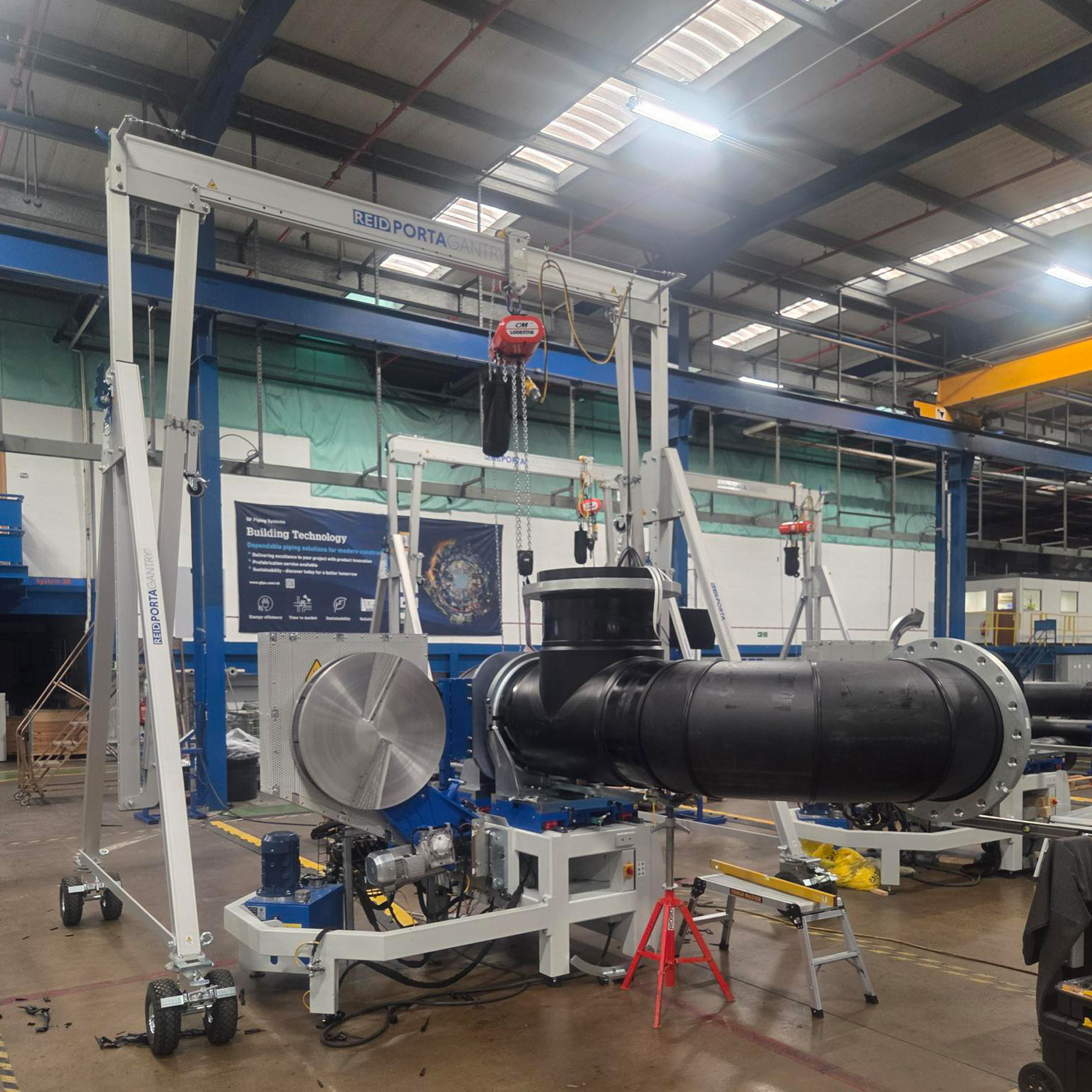
For a UK-based manufacturer of plastic pipe systems, flexibility is essential when handling large-section pipework and the customised angle and bend connections required by end customers. To support final assembly operations, Hoist & Winch Ltd has supplied and commissioned a turnkey package of eight aluminium mobile gantry cranes offering 2-ton safe working load (Swl), each equipped with a 110V single-phase electric chain hoist.
The equipment is installed in a dedicated section of the manufacturer's final assembly area, where pipe sections – used to protect electrical cables – are fitted with angle and bend connections.
The company supplies customers across a wide range of industries, including the growing datacentre sector. Flexibility was therefore a key consideration in the specification. Manufactured by Reid Lifting, the aluminium mobile gantries supplied by Hoist & Winch feature adjustable height and span width, allowing the configuration of each crane to suit the available workspace and the dimensions of the pipes that require handling.
With a maximum working hook height of 6 metres and bridge span of 4 metres, the cranes provide sufficient capacity and reach for the largest pipe sections currently processed by the company. They also offer an element of future-proofing should the manufacturer introduce larger sections.
Mobility is another critical feature. Each gantry features large pneumatic-tyred wheels, making the cranes easier to manoeuvre while improving stability when travelling under load. This capability is particularly useful when moving across raised cable ramps or small floor imperfections.
The four wheels incorporate 360-degree swivel action with directional locking at 90-degree intervals, providing operators with further flexibility when positioning the gantries. Once correctly positioned over the workstation assembly jigs, manually operated heavy-duty parking brakes securely hold each crane in place. Here, the lifting systems play a vital role in the assembly process, safely supporting pipe sections while angle or bend connections are fitted and adhesives are allowed to cure.
“It's a deceptively demanding application because the lifting equipment needs to combine substantial capacity with the freedom to move around the assembly area,” explains Hoist & Winch Director Andy Allen. “The aluminium gantries give the customer that flexibility, while the 2-ton Swl hoists offer the reliable lifting performance needed for these large and varied pipe sections.”
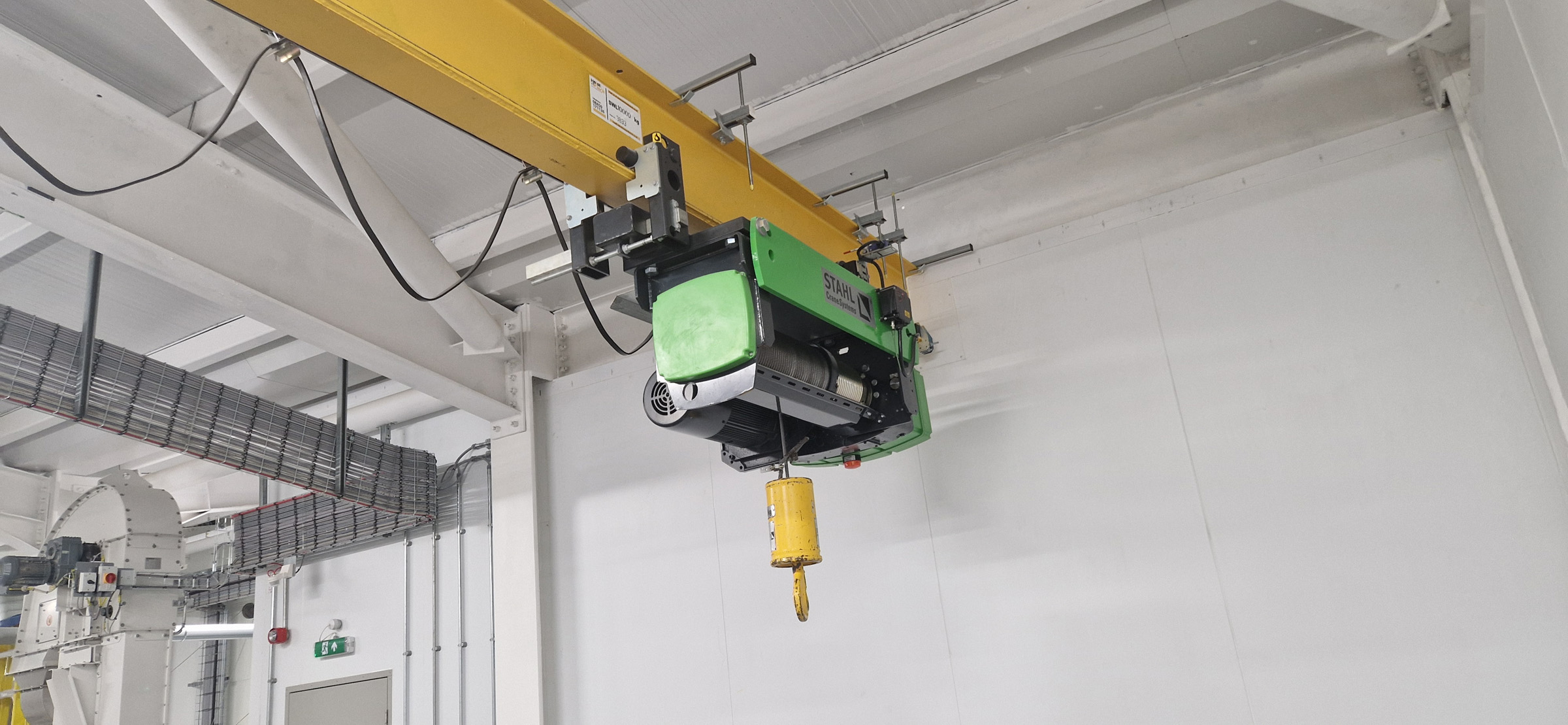
To provide effective and electrically safe lifting within the assembly environment, Hoist & Winch installed heavy-duty 2-ton Swl Yale/Loadstar 110V single-phase electric chain hoists. The low-voltage supply is particularly appropriate because the gantries require powering via a trailing floor cable as the company moves them between workstations. Hoist and pendant control cables are managed across each crane bridge using a taut-wire festoon catenary system, helping to maintain orderly cable routing while allowing the hoists to travel along the bridge.
Following installation, Hoist & Winch completed LOLER (Lifting Operations and Lifting Equipment Regulations) inspection and testing of each complete lifting system and issued the appropriate LOLER Thorough Examination reports, providing complete peace of mind for the customer.
On-site operator training covered equipment functionality, hoist components and operating controls, including top and bottom limit switches and emergency-stop functions. Training also addressed periodic checks and lubrication, together with annual inspection, servicing and certification requirements. Each operator was given practical experience in using the equipment, ensuring safe and effective operation of the new lifting systems from day one.
Visit www.hoistandwinch.co.uk for further information and to view recent case studies.
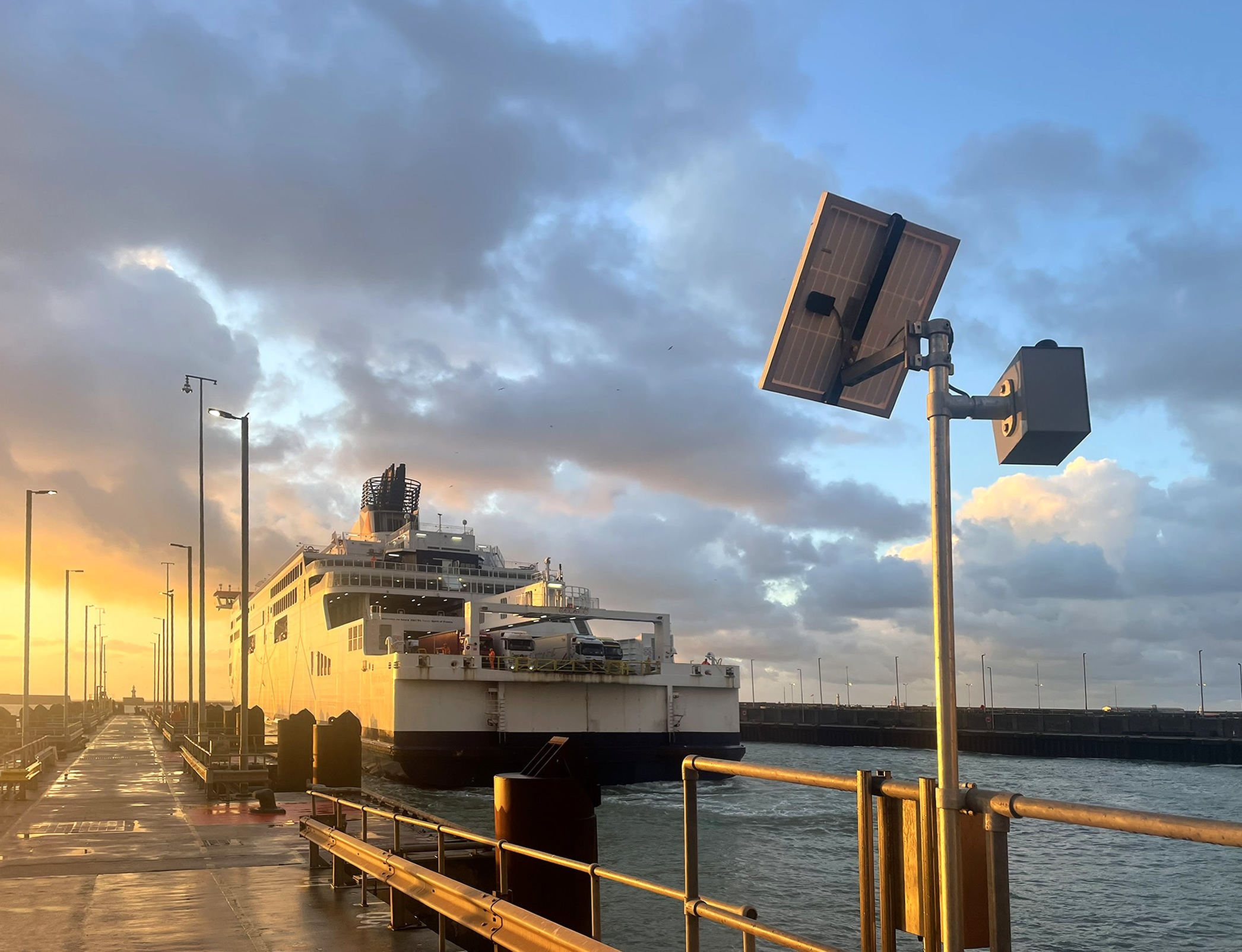
The Port of Dover has installed an advanced monitoring system with integrated Meteor MRC cameras to gather data on ferry berthing events and the real-world performance of berth fender systems. The project aims to gather data that can be used to better inform maintenance planning and alert the port’s asset engineers to any significant berthing events that might compromise the effectiveness of the berthing fenders.
Sensors have been installed to measure the magnitude of fender displacement when ferries are berthing, with the MRC camera providing a visual verification of each vessel. By combining these datasets, fender displacement measurements can be correlated with individual berthing events.
“The Meteor camera provides us with ‘eyes on-site” explains Nick Slater from I&M Solutions, who has been delivering the monitoring contract with Justin Roffey of Geo-Sub Ltd. “As soon as a sensor registers an approaching vessel, the data logging system is activated, which in turn triggers the camera, allowing methodical collection of berthing data. This improves the response time for the port’s engineers, saves time and money, and provides valuable operational context to support informed maintenance, asset integrity and future fender management decisions.”
Ensuring safe operations in a busy port
The Port of Dover is the UK’s busiest international ferry port, handling over 11 million passengers and 33% of the UK’s trade in goods with the EU. It is therefore necessary for ferry arrivals (approximately 2 per hour) to access the port in a safe, sustainable and timely manner. To support this, each of the port’s 6 car ferry berths are fitted with a range of different fender designs in order to absorb low velocity forces when a ferry berths. This makes the berthing process smoother for passengers, whilst also reducing the potential for damage to either the quay wall or the vessel.
Periodically, the fenders require routine service and maintenance to ensure long-term optimal performance. These interventions are typically time-based, and for a pre-specified number of compressions. Traditionally, maintenance schedules are therefore heavily informed by fender manufacturers’ published specifications.
With the monitoring system in place the operational and maintenance teams at Dover are now able to use quantitative measurements, to inform maintenance scheduling and planning for repairs. This helps to extend the life of the fenders and reduce the likelihood of any reactive interventions that may require a berth to be closed, temporarily reducing port capacity.
Port of Dover fender monitoring system
One of the primary considerations when designing a monitoring system for a UK port, is the robustness of the equipment. Storms, waves, salt spray and high winds combine to present a particularly challenging location for precise measurements.
Geo-Sub / I&M Solutions installed a long-range Vega radar sensor to detect ferry arrivals at the berth. A further 5 sensors were installed at selected fenders, measuring the distance from the quay wall to the rear of the fender, with all data captured by bespoke wireless loggers. Once a vessel is detected, the 5 fender sensors are activated, instructing the loggers to record measurements at 5Hz while the vessel berths.
A specialist remote camera from Meteor Communications monitors the sensors and records images for each ferry docking. Meteor’s MCE mini pillar camera with IR illuminator was installed towards the end of 2024, and Nick Slater says: “It has performed flawlessly for the past year, delivering high-quality images in all weathers to corroborate sensor data, and enable us to view site conditions without requiring engineers to attend the berth unnecessarily.” Reflecting on the choice of remote camera, Nick adds: “I have installed hundreds of MRC cameras over the past 10 years and have no doubts about their reliability and performance.”
The Meteor camera communicates via secure mobile network links with image visualisation provided by the MeteorCloud® platform - a secure web portal for viewing camera images, diagnostics and historic imagery.
Summary
The deployment of the fender monitoring system has delivered a number of important benefits:
- Measures cyclical compression of fender components, and identifies any reduction of fender performance
- Supports condition-based maintenance scheduling, rather than relying solely on fixed time-based intervals:
- Lowers costs
- Improves berth uptime
- Lowers operational carbon footprint
- Improves both ferry and port safety
- Provides ‘eyes on site’ and helps engineers assess conditions remotely where appropriate.
- Informs future fender design.
Looking forward, Gennaro Acquaviva, Senior Engineer at the Port of Dover says: “The combined camera and fender monitoring system has given us valuable insight into the real-world performance of our berth infrastructure. By combining fender displacement data with visual records of berthing operations, we can better understand the forces being imposed on the fenders and how the system responds over time.
“The key benefit for us is the ability to make more informed engineering decisions. This data supports condition-based maintenance, improves our understanding of fender integrity, and helps us plan replacements or design improvements based on evidence rather than assumption. This has important benefits for safety, operational reliability and cost control, while also supporting sustainability by helping us avoid unnecessary replacement of serviceable components and reducing the carbon impact associated with premature asset renewal.”
Meteor’s products provide real-time access to vitally important field data, with two main themes. Remote water quality monitoring stations measure background levels, enabling trend analysis and the identification of pollution from diffuse and point sources. Remote, low-power, rugged cameras provide visualisation of key assets such as construction sites, flood gates, weirs, flumes, screens, grills etc. Both the cameras and the water quality monitoring stations provide immediate access to current conditions with alarm capability, which enables prompt remedial action, as well as the optimisation of maintenance activities.
Meteor Communications provides a wide range of off-the-shelf and bespoke monitoring solutions. Most can be deployed within minutes, are solar powered and do not require significant infrastructure to run. Cloud-based data is accessed via secure login to the Meteor Communications data centre. This is achieved using any web-enabled device and provides instant access to live and stored data, which includes an interactive graphical display.
Meteor Communications has a large installed base of remote monitoring stations and the company’s turnover has increased rapidly. In 2026 Meteor Communications was included in the Sunday Times 100 Tech - Britain’s fastest-growing private technology companies.