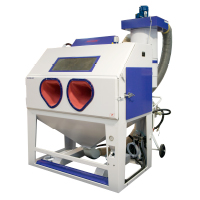
 Leading industrial finishing equipment manufacturer Guyson Internationalofferplastic injection moulders the complete package of maintenance cleaning equipment for moulds, dies and injection lead screws. Cleaning contaminations from injection tooling, without dimensional change to the geometry or degradation of the mould material itself, is vital to maintaining optimum performance. Now, for many companies in this sector,Guyson has become their preferred supplier as it is distinctive in manufacturingtwo of the most effective methods for cleaning tooling;offering numerous dry blast and ultrasonic cleaning options, and providing whichever is best suited to the exact tooling form; and both manufactured in Guyson’s own factory in Skipton, North Yorkshire.
Guyson’s method of supporting customersstarts with test and evaluation, and recognises that the only true way to recommend injection mould cleaning equipment is to prove the machine and process with process trials; so prospective customers are encouraged to submit sample components for free feasibility testing in the company’s extensive development workshop.
Once the injection moulds or injection mould screws arrive at Guyson they are taken to the test facility to undergo a comprehensive series of cleaning procedures to ascertain whether blasting - without dimensional change, or ultrasonic cleaning is the best solution. This recommendation is not only based on the most appropriate cleaning method but also takes into consideration component size and weight, throughput volumes, factory space availability, budget, health and safety and environmental issues.
Once a recommendation is made a quote is issued and this is progressed through the sales channel with local visits and consultations from Guyson’s team of sales engineers; sales and service personnel are located throughout the UK.
Ultrasonic Cleaning Injection Moulds
Ultrasonic cleaning is used for removing tough burnt on residues from mould faces or degreasing and cleaning assembled moulds without the needs for mould disassembly. This cleaning without the need for stripping, can sometimes offer a significant advantage over dry blasting methods.
User can choose between Kerry KS and UCR tanks.The difference being that UCR models offer an integrated second tank used for rinsing and hand spray nozzle for rinsing off the part. Numerous standard size options are available for both models and special sizes can be made to order. All are robustly constructed using AISI 316L polished stainless steel tanks for durability, whilst Kerry Pulsatron ultrasonic generators ensure powerful parts cleaning and long equipment life.
The injection moulds are placed in the steel constructed basket and then gently lowered into the cleaning tank. Very heavy moulds may need a supporting grill lower floor inside the tank to help support their weight. The cleaning time is then selected in the membrane keypad andthe LCD panel displays the temperature and time set by the user, the time elapsed since the start of the cleaning process, and the status of the power supply, heater and ultrasonics.Guyson’s Kerry KS ultrasonic tanks have been designed to achieve optimum cleaning results using safe aqueous solutions.
Ultrasonic transducers bonded to the tank base provide high performance and reliability together with uniform distribution of the ultrasonic energy butif high degrees of loose contaminant is encountered during trials – side mounted transducers may be recommended to provide more effective cleaning – as the loose soil dropping to the base of the tank can reduce base mounted transducer effectiveness under certain conditions.
Transducer frequency is factory tuned to the individual tank/transducer combination and then optimised under normal usage conditions with frequency sweep and fully automatic tuning.
Ultrasonic cleaning takes place directly on the component surface and in the crevices and injection holes. The actual ultrasonic cleaningaction is created by something called ‘Cavitation’ - where millions of miniscule cleaning bubbles are generated by alternating pressure waves created in the wash solution. These waves create cavitational bubbles which grow and then implode when at an optimum size, producing an extremely high energy scrubbing action that imparts the cleaning.
Blast Cleaning Moulds, Dies and Screws
Sometimes, depending on substrate and maintenance cleaning regimes, blast cleaning is a better option than ultrasonic cleaning for injection mouldcleaning and Guyson’sEuroblast®range of Pressure Fed blast cabinets are perfectly suited tothis job. Blasting allows localised attention to particular troublesome areas where residue material builds up most and provides controlled aggressive cleaning without the harmful effects, both to the dies and operators, which some manual cleaning methods can inflict. Blast cleaningis also highly capable of removinghardened residue plastic from case hardened steel injection mould screws; used in theinjection mould manufacturing process.
The Guyson Euroblast PF (pressure fed) systems are designed for speed, giving faster cleaning times (up to four times faster than suction fed venturi systems) to meet higher production requirements, pressure feed blast systems are excellent for removing tough, hard scale and deposits particularly within hard-to-reach recessed areas and complex shapes.
As a result of the speed of the blasting process, maintenance cleaning can take place on a more frequent basis so lessening the inevitable process build-up of residual plasticson the steel injection mould screws. The blast media used is a specialist plastic blast media sold by Guyson, that is aggressive enough to remove the residue, but without causing any damage to the precision screw threads.
Blasting takes place in a well illuminated sealed cabinet, so the operator is not exposed to any hazardous debris flying about, cuts from knives or wire brushes or odours and spills from acid baths; all that can be present in manual cleaning operations. The plastic blast media is fired at the encrusted screw threads or die by a high impact stream of air generated from a Guyson G27 (27 litre) pressure pot and directed at the point of impact through a blast nozzle, so precise cleaning can take place exactly where it is needed.
A standard blast system also includes a Cyclone Separator and Dust Collector. The cyclone separator maintains a consistent grit size with the media stream to achieve consistent roughness level. The Guyson 75/16 cyclone separator creates a vortex of air that carries the heavier re-usable particles to the outside of the rotating air stream which collect in a storage hopper ready to be re-used, whilst the lighter remaining dust, fines and undersize media are separated and collected in the Guyson C400 cartridge dust collector for disposal.
Additional machine options include side loading platforms equipped with turntables so that heavy moulds can be mechanically lifted onto the turntable and then slid into the cabinet for blasting, whilst allowing rotation of the product. Or alternatively a roof slot option is available so that heavy items can be positioned directly into the cabinet whilst suspended on chains. For a free four page brochure on Guyson’s mould and die cleaning equipment options pleasecontact Guyson’s Customer Service team now on 01756 799911 or email This email address is being protected from spambots. You need JavaScript enabled to view it.
website: www.guyson.co.uk
Guyson International Limited
Snaygill Industrial Estate, Keighley Road,
SKIPTON, North Yorkshire, EnglandBD23 2QR
Tel: +44 (0)1756 799911 Fax: +44 (0)1756 790213
email: This email address is being protected from spambots. You need JavaScript enabled to view it. website: www.guyson.co.uk

 The new Baker DX series of static motor analysis equipment from SKF replaces older-generation Baker D-series and ST series surge test analysers. The DX is ideal as an entry level instrument for performing motor and generator analysis in areas such as industrial motor test/maintenance, motor servicing and OEM manufacturing.
 Enclosure climate control calculations can now be carried out, on the move, using the Rittal RiTherm smartphone app.
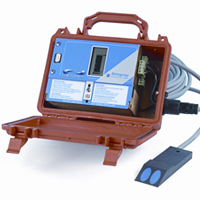 Packaging potatoes may seem like a straightforward industry but there are significant challenges including monitoring the flow rate of effluent from sites. This is particularly difficult in locations where there is no mains power available. Such was the case for one of the UKs leading suppliers who have packing and processing sites located around the main potato growing areas in the Scottish borders. They needed a system that could stand alone and would provide a logged reading for their local trade effluent officer to check as and when necessary. Effluent leaves the site via a pipe with an internal diameter of 150mm and this pipe often runs with a very shallow depth of effluent. The pipe empties into a brick channel which is open to the atmosphere, so any gauging structure that was installed in this channel could give false high readings as it would not only be measuring the site’s effluent, but also surface water and rain water, it was therefore imperative that the flow measurement took place in the actual effluent pipe.
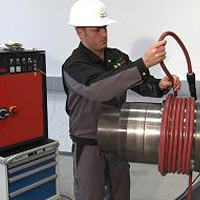 Precision bearing supplier Schaeffler has launched an online, interactive information guide on how to correctly install rolling bearings and the tools required to do this.
 Lifecycle Cost Analysis: The Key to Asset Sustainability
 Seaward's latest multi-purpose portable appliance tester is specially equipped to carry out the 'point to point' testing of fixed appliances, as recommended by the 4th edition of the IET Code of Practice.
 Seaward's latest electrical safety tester establishes a brand new approach to portable appliance testing.
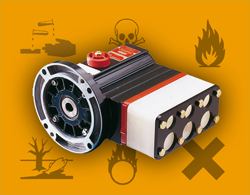 Hydra-Cell® pumps dangerous liquids
 The latest edition of the James Walker Guide to Elastomer Engineering draws on the company's experience of elastomer formulation, compounding and processing and has been developed as an introduction and reference guide to all aspects of elastomer engineering.
 Idhammar Systems, providers of market leading maintenance and manufacturing systems, announced the launch of the latest version of their Maintenance Management System V11, this month [December 2012]. The new features promise new levels of efficiency for Idhammar CMMS users and new users alike. With its extended functionality, V11 has been designed to further support the efficiency improvement initiatives required for manufacturers to achieve an efficient and lean maintenance operation.