
Mark Donoghue, Products and Services Director, DHD Cooling
It is now more common to read about cases of Legionnaires’ Disease in the media than ever before, with outbreaks regularly being reported in cities around the world all the time. Many of these cases are attributed to contamination of domestic systems, showers and spas, but some are the result of operating cooling towers.
Whilst this problem is not new, with the first reported case in Philadelphia in 1976, the UK has been at the forefront in leading the battle with Legionnaires’ Disease, which has a mortality rate of approximately 10%.
The Health and Safety Executive (HSE) worked with manufacturers and industry experts to issue the Approved Code of Practice L8 in 1991 which advised manufacturers, owners, operators and service providers on the use of cooling systems (and domestic water systems) and their safe operation with regards to legionella bacteria.
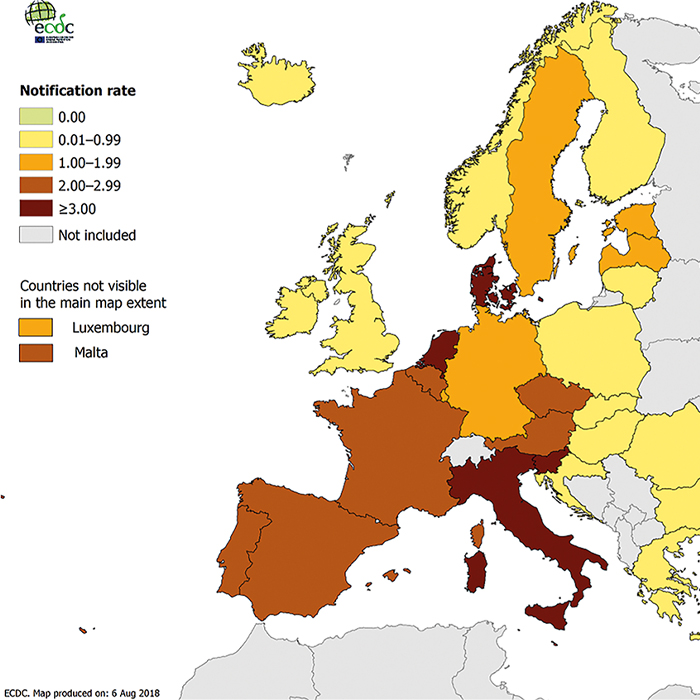
From data available via the European Centre for Disease Prevention and Control in their Annual Epidemiological Report 2018, there were 10,672 cases of Legionnaires’ Disease across Europe. Germany, France, Italy and Spain accounted for 71% of the cases, with UK cases only accounting for 5%. Outbreaks in the UK in fact are becoming more and more infrequent, which has led to the question, why is this not the case elsewhere?
Tackling legionella bacteria
In the UK, the HSE has led the drive to reduce the incidence of legionella bacteria in water systems with their two documents, ACoP-L8 and more recently HSG274 Pt1. This has seen the numbers of cases within the UK become the lowest of the main manufacturing nations of Europe.
Legionella bacteria exists in fresh water so can be introduced into cooling systems through the make-up water line if the water is not treated. Added to that, when given the right conditions - water temperatures between 20℃ and 45℃, stagnation in pipes, accumulation of dirt or scale, sunlight, and a food source - it can multiply to dangerous levels within a water system. When contaminated water is introduced into a stream of air, the bacteria can become airborne which is known as drift, and if this is inhaled, it can become a serious risk to health.
There are several ways of tackling the issue of legionella in cooling systems, and these should be used in conjunction with each other to comply with the HSE’s guidance.
The cooling system (the cooling tower and everything associated with it) should be designed so that risks of bacterial growth are minimised. This covers actions such as the removal of dead-legs in the pipework, designing the system so that it is easy to clean and maintain, using materials of construction that are not favourable to bacterial growth and minimising the release of drift.
Legionella can be introduced from the water inlet, so treatment of the system is needed. This will typically involve dosing the system with biocides that kill the bacteria, corrosion inhibitors to limit corrosion (which can act as a food source) and scale inhibitors which prevent build-up that provides a protective layer and prevents the biocides from working effectively.
Physical maintenance is crucial, and comes in the form of cleaning debris and ensuring contamination is removed from the system and the heat exchange media. It also involves reviewing the system to ensure that the correct materials are installed to minimise the risk of legionella and that they are working correctly. Preventative measures such as painting the internals of systems can also help stop process water coming into contact with the corrosion and can extend the life of the system.
Legionnaires’ Disease is still a very real threat
Keeping cooling equipment operating safely is not the same as making sure your equipment operates effectively. Owners of cooling systems should not be complacent with keeping their equipment clean and maintained, as bacteria is still a very real possibility in cooling systems.
Legionella bacteria is naturally present in water and in the right conditions can proliferate, so it is important to minimise the risk of this occurring by implementing controls in the form of good system design, effective water treatment and monitoring, cleaning and maintenance of the system using qualified suppliers. If these measures are followed the control of legionella is achievable and organisations are on their way to becoming responsible users of cooling systems and helping to keep the UK as the pioneers in the fight against Legionnaires’ Disease.