
Why Buildings Need a Clear, Unified Picture of Their Maintenance Condition
Maintenance & Reliability Consultant, Neximatech Solutions – Houston, TX
1. Introduction – Unexpected Costs and Constant Surprises in Building Management
“I’m overwhelmed by these endless costs.”
“Residents keep complaining one after another.”
“Breakdowns appear out of nowhere. How am I supposed to handle all of this?”
“And why should I keep spending when this building barely generates income for me?”
Almost every building owner or property manager has had moments like these. Concerns that keep resurfacing, and surprises that seem to show up exactly when you least expect them.
This brings us to the core question:
Why does a building fall into such a situation in the first place?
2. Hidden Challenges – When Information and History Don’t Exist
Many of these concerns originate from a series of hidden gaps issues that aren’t visible at first glance. The most critical one is the absence of reliable information and historical records.
To put it simply:
When we don’t know exactly what assets the building has, which ones are critical, what work has been done, and how much has already been spent, the entire operation shifts into a guessing game.
This lack of visibility shows its real impact during an unexpected failure.
In those moments, quick and accurate decision-making becomes nearly impossible. Sometimes the wrong decision made under pressure can even cause additional issues, creating a chain reaction of new problems.
We also can’t ignore the role of a building’s age and natural deterioration. Just like people, buildings wear out over time. But we all know elderly individuals who remain remarkably healthy and energetic thanks to continuous care and attention.
Buildings behave the same way: with timely maintenance, they become more stable, more predictable, and far less costly to operate.
3. The Solution – Building a “Digital Memory” for Your Property
So how do we prevent these challenges or at least significantly reduce them?
You’ve probably heard the well-known saying:
“You can only control what you can measure.”
This principle applies directly to building management.
The most essential step toward eliminating blind spots is creating a structured, unified system for documentation.
Key categories of documentation include:
- Architectural drawings and technical documents
- Asset information and criticality ranking
- Failure history and cost records
- Routine and preventive maintenance schedules
You might think:
“I already have all of this organized in drawers or binders.”
But there is a huge difference between having documents and having usable, analyzable information.
This is where a digital, integrated tool becomes essential something that organizes the building’s records, connects them, and presents them as one cohesive, decision-ready picture.
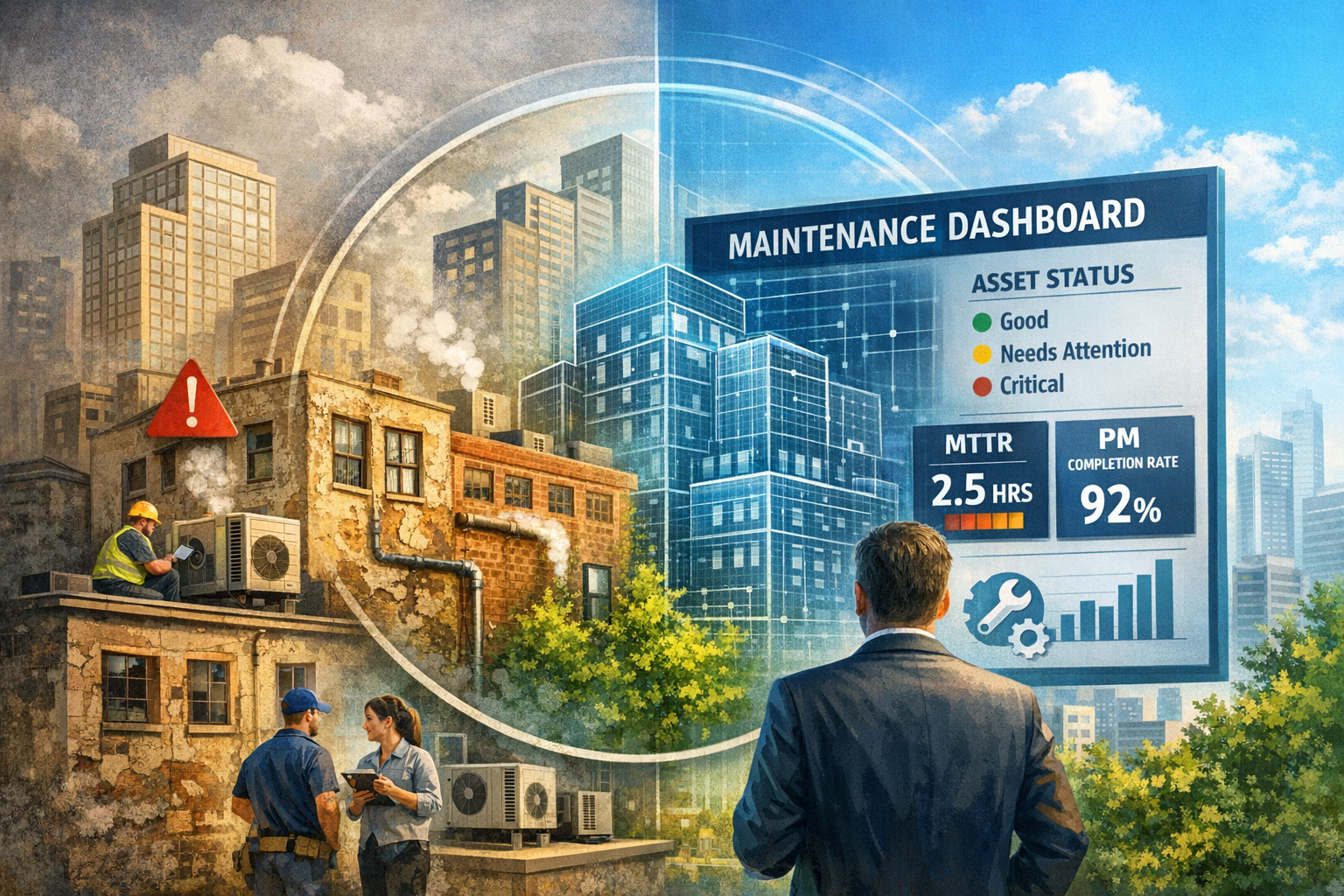
That unified picture is what we refer to as a Building Maintenance Dashboard.
4. Creating a Maintenance Dashboard – The Simplest Path to Clarity
The purpose of a dashboard is not merely to display information.
Its real value lies in creating clarity, coordination, and predictability across the building.
1) Transparency about assets and their history
A dashboard clearly shows what assets exist, their current condition, the maintenance performed on them, and the failures recorded over time.
2) Tracking equipment health and planning future actions
In a single view, you can see the building’s current status and what actions are needed in the coming weeks or months.
This shifts management from reactive to proactive.
3) A shared communication platform for owners, managers, residents, and technicians
A dashboard creates a common language for all stakeholders.
Residents can see the status of their reported issues.
Owners can monitor cost trends.
Managers and technicians always work from a single, aligned view.
4) A snapshot for quick decision-making
With one glance, an owner or manager can understand the building’s overall condition without hunting through binders or scattered files.
Adding Two Practical KPIs to the Dashboard
Two of the most common and useful KPIs in building maintenance dashboards are:
1) Mean Time to Repair (MTTR) / Average Resolution Time
This indicates how long it takes to resolve reported issues.
The lower this number is, the higher the resident satisfaction and the lower the emergency repair costs.
2) Preventive Maintenance Completion Rate (PM Completion Rate)
Displayed as a percentage, this KPI shows how consistently routine maintenance is carried out.
A higher percentage signals a preventive and care-focused approach.
A lower percentage indicates a “run-to-failure” pattern often leading to higher risks and unexpected expenses.
5. Conclusion – The Path Toward Professional, Predictable Maintenance
By following this structured path, maintenance activities gradually shift from being perceived as an “unnecessary expense” to becoming a meaningful long-term investment. Just as continuous care helps an elderly person stay active and healthy, consistent and timely maintenance allows a building to remain stable, predictable, and cost-efficient throughout its life cycle.
When this mindset is adopted, decision-making naturally transitions toward a data-driven approach. Managers and owners no longer rely on assumptions, incomplete information, or reactive judgment. Instead, decisions are supported by documented history, asset behavior, and objective indicators. The result is a building environment where uncertainty decreases and control increases.
One of the most tangible outcomes of this shift is improved resident satisfaction. When issues are resolved faster, when communication is clearer, and when the building feels well-maintained, residents experience a higher quality of life. This sense of confidence and comfort translates directly into increased long-term value for property owners, both financially and reputationally.
It is also important to remember that housing remains the largest monthly expense for most families, typically more than 35% of their income.
With such a significant share devoted to housing, it is only natural for residents to expect comfort, stability, and minimal disruption. A professionally managed maintenance system is the most reliable way to meet these expectations.
Ultimately, moving toward a standardized and professional maintenance approach is no longer a luxury or an optional improvement. It has become a necessity for the modern building industry. As buildings grow more complex and resident expectations continue to evolve, the ability to manage maintenance proactively and based on reliable data will define which properties stay competitive and which ones fall behind. Embracing this shift sets the foundation for a healthier, more predictable, and more resilient future for all stakeholders involved.
This article was written by Farshad Bakhshi Founder & CMMS Consultant at Nexima

Explore EMS
More Editorial
Directory
This website is owned and operated by: MSL Media Limited

Co. Number: 05359182
© 2005 MSL Media Ltd. All rights reserved. E&OE