

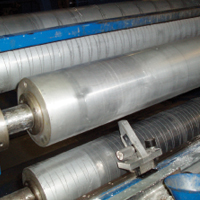
 Web tension effect is achieved when opposing longitudinal forces are exerted on any substrate (e.g. paper, film, board, cable). Experts in the converting and printing processes know how critical good tension control is to their process and that tension can represent a single point of failure during production. Accurate and stable tension control on driven material ensures:
- Higher quality product
- Less scrap and, therefore, improved productivity
- Higher production speeds
- Improved downtime and lower operating costs
Good web tension control systems ensure that no matter how demanding the production process is, the correct web tension is maintained for any type of material, at any point of the machine and at any speed.
Open Loop vs. Closed Loop Web tension control - What is the difference?
In an open-loop control system there is no direct tension feedback signal so controlled corrective action for any web tension variance is not possible. They operate on a predictive load basis.
In contrast, a closed loop tension system uses a signal (generally an electrical one) that is proportional to the position of a feedback transducer (i.e. load cell or dancer mechanism) that is pre-tensioned as determined by the main process requirements. The control system uses a PID controller (proportional, integral and derivative controllers are essential elements in a tension control system but fall outside the scope of this report)
There is a cost-performance payoff between both alternatives; high performance closed-loop systems provide accurate, consistent tension control. Colin Keating, an experienced design engineer at Optima Control Solutions Ltd., talks further about two popular types of closed-loop tension controllers – dancer mechanisms and electrical load cell transducers. Colin has been part of Optima’s engineering team since 2007. Web transport applications are among his specialist disciplines. With more than 19 years of control systems engineering experience, Colin talks here about the two closed loop web control systems from a practical point of view.
| Advantages of dancer control systems | Disadvantages of dancer control systems |
| Easy to set up | Difficult to design mechanically |
| Ability to accumulate web; more ‘forgiving’ of variation in speed | No direct capability of measuring and responding to tension values |
| Easy to commission and debug | Low tensions are problematic – the dancer induces more tension from mechanics |
| Advantages of load cells | Disadvantages of load cells |
| Accurate flexible measurement and control of tension | Not responsive to disturbances in the production process. |
| Low maintenance requirement due to simple arrangement | Harder to commission and debug |
| Compatible with digital communication networks |
[Colin, in the tables above you have summarized the pros and cons of both dancer rolls and load cells. Are dancers easier to maintain for maintenance engineers on a production site?]
Not necessarily. Load cells are mechanically simpler than dancers. The only moving (wearing) part on a load cell is a bearing that it is quite easy to replace. With a more complex dancer system, in contrast, one needs to maintain whatever the pivot point is (whether it is a cylinder, or chains and weights). Another more technical issue that occurs in dancer systems is the inherent non-linearity of the feedback signal that the mechanical experts need to consider in their designs. The mechanical parts must not tighten the web.
[Can you recall any particular projects that you have engineered involving dancers?]
The most impressive project I can think of is one that we supplied to CCL Decorative Sleeves in Kings Lynn. Their printing machine had a flying splice winder section. (Please, scan the QR code to access the flying splice winder video). I remember it because in short, someone had removed the original dancer mechanism (it used weights) and replaced it with a load cell arrangement believing that the load cell would provide better accuracy. The machine would then only splice for 1 out of 3 attempts; clearly unsustainable. They contacted Optima for our advice. Experience told us that the application needed a dancer mechanism but in a much more modern arrangement. The difficulties in using load cells on a flying splice were then all too apparent to CCL.
CCL found that when switching the tension control from one roll to the next one, in the splicing sequence, the whole control system was disturbed within a fraction of a second and using the load cell meant it lost tension. We engineered a new dancer system with very low friction components and achieved reliable splicing for them with ease.
Most of the flying splices we have done have dancers because of the accumulation advantage mentioned above. If a load cell is used for this type of process, the disturbance created by other splicing component rolls and knifes can easily cause the web to jump off the roll. The dancer absorbs the shock and allows the control system to overcome the short disruption.
[What about load cells? What circumstances necessitate their use?]
Certain pieces of equipment need the material to be at a guaranteed tension. A printing press, for example, will need accurate and stable tension control. A print register system ensures that all the colours are printed accurately with respect to one-another It will only work well if the substrate being printed on is stable and running at the correct tension value. The printer will need to control his substrate flexibly and accurately to accommodate different materials. Another common requirement is for the tension levels to be different for various sections on a machine. If the web is transported or wound at too low a tension it can wander from side to side causing process problems (e.g. print registration issues) or poor winder performance (the so-called “telescope” phenomena).
Conversely, too much tension can deform a substrate or cause problems on the surface of the material.
One obvious advantage using load cells is their operational flexibility. Operators change the web tension simply by changing a number on a HMI or a potentiometer dial. It is possible to make adjustments to dancer system in a similar way using E-P transducers, but still the whole system is not as flexible.
[What are the recent technological developments for load cells?]
At present, load cell technology is so widely developed that dancers have become the more costly solution. Also, in applications where low web tension is required, dancers are not suitable – dancers contain inherent mass and inertia that the web must overcome.
The most significant innovation on the load cell control technology is the shift towards digital controls. The latest load cell amplifiers employ intelligent tuning techniques and digital communications networks (e.g. ProfiBus).
[What are the typical web tension control issues of our customers?]
Our clients experience a range of issues. Improving process and machine reliability is one reason why they get in touch with us; increasing production speed is another.
We have completed projects that involve a straightforward control system upgrade through to more mechanically complex projects where we have removed existing line shaft arrangements and introduced individual section controls providing faster setup times and much better flexibility for the operators.
The majority of our customer applications use load cells, not dancers, though understanding which applications necessitate the use of one or the other (or a combination of the two technologies) means we still employ dancers where the process requires. This is where Optima have a great deal of expertise and experience. As per our example, a butt splicer might work easily with a load cell system but it is a different story for flying splice winders, this type of knowledge is critical to a projects success.
{jcomments on}