
To detect problems, the professional “listens” in many ways:
• With eyes and ears, to see and hear conditions that may indicate problems
• With thermometers and thermal imagers, to detect overheating, poor electrical connections or failing bearings
• With digital multimeters and power analysers, to diagnose electrical problems
• Using techniques like lubricant analysis, to gauge machine condition over time.
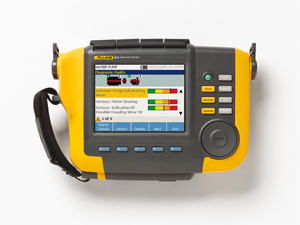
And now the maintenance professional has a valuable new way not just to listen, but to find mechanical problems and fixes: the Fluke 810 Vibration Tester. It’s a unique new kind of troubleshooting tool, engineered to detect and evaluate machine vibration immediately and recommend any needed repairs.
A new kind of troubleshooting tool
Many industrial maintenance teams today work under severe restrictions on money and time. They may not have the resources to train for and implement the typical long-term vibration analysis program. The Fluke 810 is designed specifically for maintenance professionals who need to troubleshoot mechanical problems and quickly understand the root cause of equipment condition.
The handheld Fluke 810 is designed and programmed to diagnose the most common mechanical problems of imbalance, looseness, misalignment and bearing failures in a wide variety of mechanical equipment, including motors, fans, blowers, belts and chain drives, gearboxes, couplings, pumps, compressors, closed coupled machines and spindles.
Many professionals may think there are only two options for vibration testing; high-end vibration analysers that are expensive and difficult to use, and low-end vibration pens which are not particularly accurate. The Fluke 810 fills the middle of the category as it combines the diagnostic capability of a trained vibration analyser with the speed and convenience of lower-end testers, at a reasonable price. It is a new type of test tool for vibration testing.
The Fluke 810 is not merely a vibration detector, but a complete diagnostic and problem- solving solution. The diagnostic technology in the Fluke 810 analyses machinery condition and identifies faults by comparing vibration data to an extensive set of rules and algorithms developed over years of field experience. The Fluke 810 determines fault severity using a unique technology to simulate a fault-free condition and establish a baseline for instant comparison to gathered data. This means that every measurement taken is compared to a “like new” machine.
Not just data, but actionable results
When it detects a fault, the Fluke 810 identifies the problem, its location and its severity on a four-level scale to help the maintenance professional prioritise maintenance tasks. It also recommends repairs. Context-sensitive on-board help provides new users with real-time guidance and tips.
Mechanical diagnosis with the Fluke 810 begins when the user places the Fluke tri-axial TEDS accelerometer on the machine under test. The accelerometer has a magnetic mount and can also be installed by attaching a mounting pad using adhesive. A quick-disconnect cable connects the accelerometer to the Fluke 810 tester. As the machine under test operates, the accelerometer detects its vibration along three planes of movement (vertical, horizontal and axial) and transmits that information to the Fluke 810. Using a set of advanced algorithms, the 810 Vibration Tester then provides a plain-text diagnosis of the machine with a recommended solution.
No training? No problem
Mechanical equipment is typically evaluated by comparing its condition over time to an established baseline condition. Vibration analysers used in condition-based monitoring programs rely upon these baseline conditions to evaluate machine condition and estimate remaining operating life. System operators must have considerable training and experience before they can determine the meaning and significance of the vibration spectra they detect.
But what about the maintenance pro who isn’t trained in vibration analysis? How do you tell the difference between acceptable vibration, and the kind of vibration that demands immediate attention to service or replace troubled equipment?
The Fluke 810 provides the answer. Extensive experience with mechanical vibration, what it means and how to fix it, is built into the advanced algorithms of the Fluke 810. Now the maintenance professional can quickly and reliably determine the cause of the machine vibration, learn the severity and location of the problem and receive recommendations for repair. It’s all done with the intelligence built into the tester, without the extensive training, monitoring and recording required for typical vibration monitoring programs.
The Fluke 810 delivers plain language recommendations about what to do next. For equipment maintenance teams hard pressed and on the go, these precise directions are what they need to take action now, maintain mechanical equipment in top shape, and keep facilities productive.
Fluke (UK) Ltd.
52 Hurricane Way - Norwich - Norfolk - NR6 6JB –