
For many people, “condition monitoring” means little more than getting someone to take some vibration readings on your machines and compare the overall levels of velocity or acceleration with a standard threshold number – the sort of thing that can be seen in table A.1, which comes from ISO 20816-2.
If the readings are below the acceptable standard then the machine is OK, while if the readings are above this level, then the machine is faulty.
According to Geoff Walker from Faraday Predictive, this approach hugely undersells the value that can be obtained from a really good Condition Monitoring approach.
Firstly, using a single number to assess a machine’s behaviour is too simplistic; a single number covering the entire range from 2Hz up to 2kHZ doesn’t communicate the richer picture of machine behaviour. Machines don’t just vibrate at the same strength at all frequencies; rather they each have their own characteristic “fingerprint” spectrum with different amplitudes of vibration at different frequencies. Using a single number to represent the entire spectrum can hide all sorts of interesting behaviour in the machine.
Secondly, the levels that are appropriate for the machines used in the ISO standards such as gas turbines and generators as shown in the table are not representative of many of the machines in use in typical industrial situations. In an ideal world, you’d like to be able to compare the fingerprint of your machines against the sort of fingerprint you could expect from that same particular type of machine – like an ISO standard for each of your individual machines.
Thirdly, just condemning a machine as “unacceptable” because the overall RMS vibration level is above a particular figure doesn’t help identify the nature of the problem or provide guidance on the appropriate corrective action.
But it doesn’t have to be like this. Nowadays, the best voltage and current based systems (MBVI systems) use the drive motor as a sensor of equipment behaviour, to give a much broader perspective of machine condition, including a complete fingerprint of normality for this machine, and how this changes with different load and speed conditions, so they can provide a consistent indication of condition regardless of how load and speed vary, avoiding false alarms. They also allow you to compare your machine against baselines of normality for that general machine type – as illustrated in figure 1.
The client has 12 nominally identical machines – large, safety critical fans, operating on nominally identical duties. Figure 1 shows how most of the plots are very similar, but the red one is clearly different, with some pronounced humps and spikes around 10 hz, 50hz and 90 Hz.
Figure 2 shows how automated diagnostics allow the user to dig in and drill down – here zoomed in on the 90 Hz hump, showing that the system identifies the most likely causes of this pattern as “transmission looseness” (= rubbing friction) or foundation looseness. This gives maintenance teams a clear guide on where to focus their inspection efforts at the next maintenance.
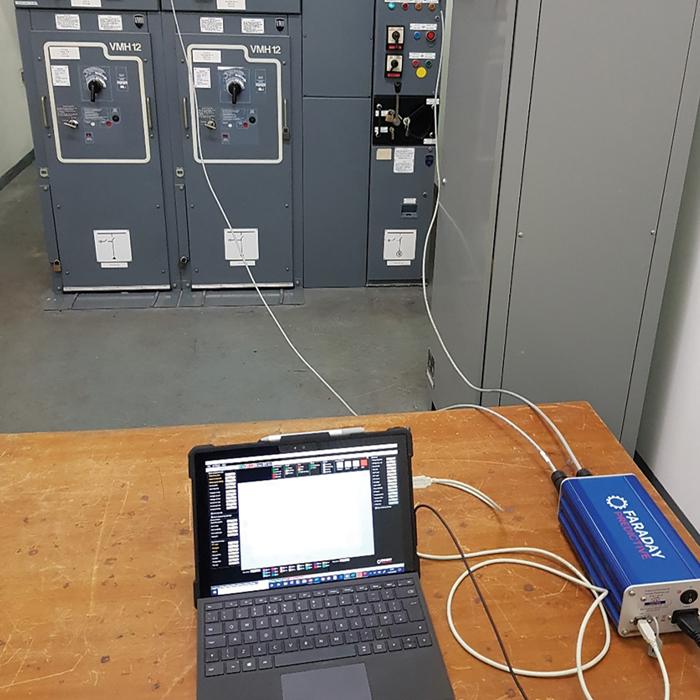
All this is done by just measuring current and voltage being drawn by the motor from the switchroom – in this case using a portable kit as shown in the photo (figure 3), but in other cases done 24x7 using a permanently installed system mounted inside the motor starter cabinet.
And this was done without opening the electrical cabinet by making use of existing protection system test sockets as shown in figure 4.
The conclusion to be drawn from this example is that monitoring the mechanical condition of your machines doesn’t always mean taking vibration measurements, and that you can do better; Model-Based Voltage and Current systems give you information on the same faults as vibration analysis, and the use of multivariate baselining to cover different speeds and load allows them to automatically diagnose specific faults whilst avoiding false alarms. And of course, being based on electrical measurements, they can provide information on electrical faults in the machine, problems with the electricity supply, and information on energy consumption and energy wastage. What’s not to like?
www.faradaypredictive.com
0333 772 0748
This email address is being protected from spambots. You need JavaScript enabled to view it.