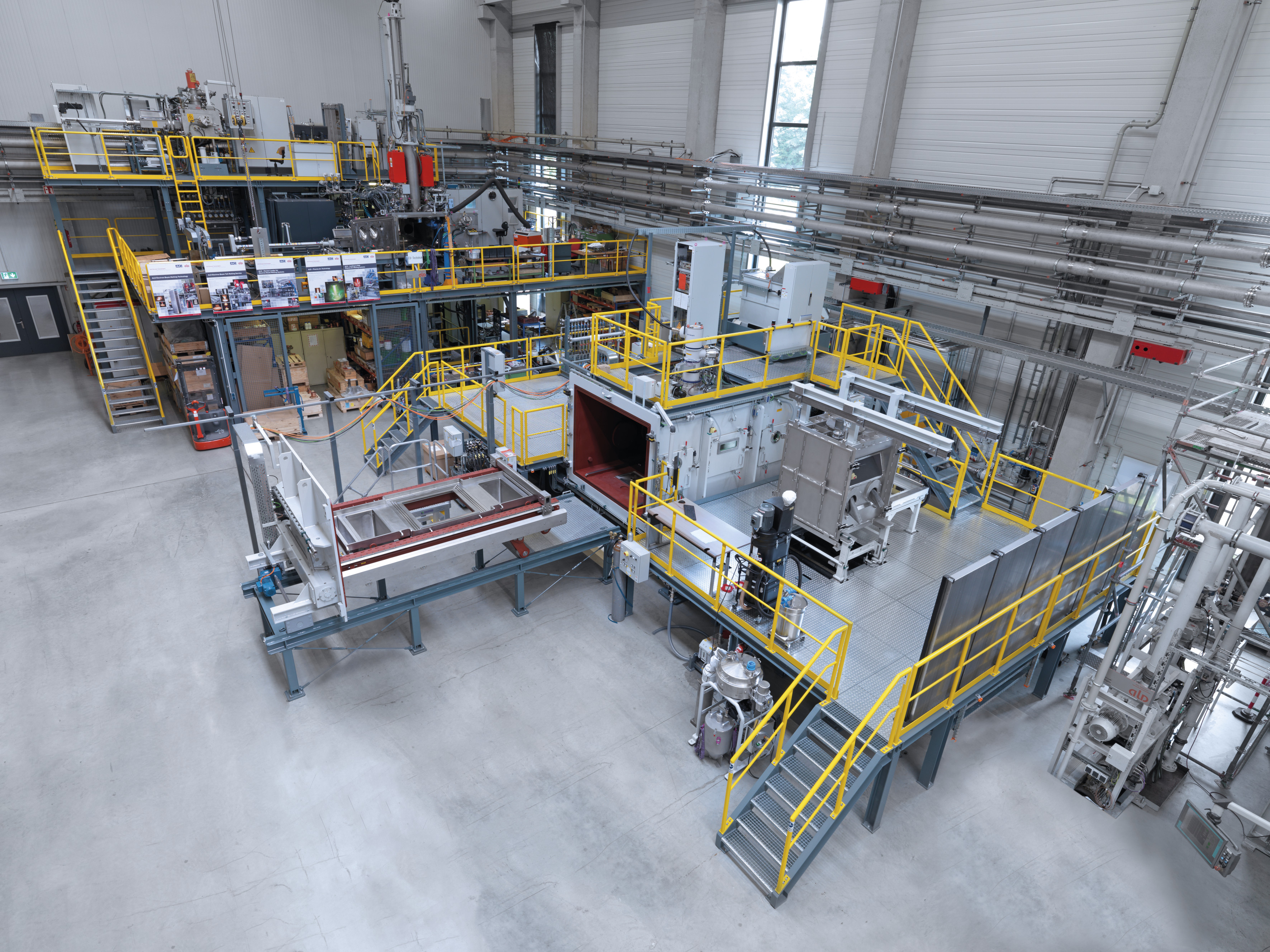
Once considered a niche technology, additive processes have now become a proven manufacturing technology, integral to modern production workflows – from prototyping to cost-effective small-batch production across diverse application areas. ALD Vacuum Technologies GmbH, based in Hanau near Frankfurt, Germany, has once again pushed the boundaries of innovation and set a new benchmark with the EBuild® 850. With the world’s largest build volume of 850 x 850 x 1000 mm³, a maximum build rate of 1000 cm³/h, and an electron beam power of 45 kilowatts, it opens new possibilities for manufacturing large, complex components. This not only boosts productivity but also enhances the efficient use of metal powder. Excess material from in-house production or off-spec batches from powder manufacturing can be reused without compromising quality. As a result, the system significantly reduces material costs, ensures efficient powder recycling, and contributes considerably to sustainability in additive manufacturing.
One of the main advantages of additive manufacturing over subtractive methods is its notably lower material consumption and greater flexibility in metal processing. “Rather than removing material, as in milling, components are built layer by layer, with raw material selectively melted using a high-energy source such as a laser or an electron beam,” explains Dr. Alexander Klassen, Vice President of Additive Manufacturing at ALD.
EBuild® 850 – Precise Electron Beam Melting for Powder Beds Up to 15 Tons and 0.01 mm Accuracy
The EBuild® 850 is built around a powerful electron beam source, a movable build chamber, a process chamber equipped with a state-of-the-art powder deposition system, and a separate extraction unit for powder preparation and component removal. To enhance production capacity, a second build chamber can be integrated: while the melting and cooling process occurs in one chamber, the other can be used for component removal and preparation of new build jobs. “In order to deliberately overcome the limitations of component size, we expanded the chamber design significantly – without compromising process stability,” explains Dr. Klassen. The high-precision withdrawal unit positions the powder bed, which can weigh up to 15 tons, with a repeatability of approximately 0.01 mm across the entire build height of 1000 mm. The material supply and powder deposition are managed by a specially developed system designed to reliably process even poorly flowing powders. To prevent unwanted temperature effects on the material, the system features an efficient water-cooling system. The development of the EBuild® 850 greatly benefited from ALD Group’s technological expertise in vacuum technology, high-temperature processes, and the precise movement of large masses. As the powder is deposited layer by layer by the powder application system, the electron beam precisely follows the predefined contour, fusing the material with high accuracy. To minimize heat loss and optimize energy usage, all chamber walls and thermally stressed components are equipped with heat shields. Like all movable components and sensors, the powder-handling valves are designed with enhanced thermal resilience, ensuring reliable operation over extended periods, even at elevated temperatures and under the influence of metal dust.
World’s Largest PBF-EB System Combines XXL Build Volume and High-Temperature Materials
With the EBuild® 850 – featuring a build volume of 850 x 850 x 1000 mm³ and a build rate of 1000 cm³/h – ALD has developed the world’s largest PBF-EB system (Electron Beam Powder Bed Fusion). This marks a decisive step towards meeting the unique requirements for manufacturing large, complex metal components within an industrially scalable solution. One of the system’s core advantages is its 45 kW electron beam, the highest beam power worldwide for PBF-EB systems. The inertia-free magnetic optics allow the electron beam to be deflected over 100 times faster than conventional systems. This high deflection dynamic enables the beam to move faster than the thermal inertia of the powder material, allowing multiple build zones to be processed simultaneously with a single beam source without affecting the melt or material quality. As a result, the EBuild® 850 offers a melting rate potential more than ten times greater than that of conventional laser systems. “This not only translates into significantly increased productivity for our customers while maintaining consistent quality, but also opens entirely new possibilities for alternative processing strategies and faster throughput,” says Dr. Klassen. Another key advantage lies in the system’s considerably higher process temperatures, ranging from 700 to 1200 °C, which also allow the processing of high-temperature-resistant materials. Titanium alloys such as Ti64, nickel-based alloys, or titanium aluminides – commonly used across various applications – can be reliably processed with ALD’s technology. Residual stresses, which can cause distortion or deformation, are minimized thanks to the high process temperatures – a critical quality factor, especially for material-sensitive components or complex geometries. Another benefit for users is the system’s separate extraction unit outside the main process chamber. Optionally, a second build chamber can be installed. This allows the next build job to be set up in parallel with ongoing production, significantly increasing overall productivity. Unproductive downtime is virtually eliminated, resulting in a noticeable boost in production output. In addition to efficiency gains, integrated process monitoring contributes to quality assurance. The EBuild® 850 uses the electron beam not only to build the components but also as an analysis tool. Each individual layer is monitored in real time, following a principle similar to that of a scanning electron microscope. This allows defects to be detected as they occur, enabling immediate adjustments to the process. Ideally, this reduces or even eliminates the need for subsequent inspection procedures, further enhancing process reliability and component quality.
From Cost-Intensive Material Use to Resource-Efficient Production
A central challenge lies in the efficient handling of metal powder – particularly when it involves recycled or off-spec material from the powder manufacturer. The EBuild® 850 opens up new possibilities: its high power of 45 kW, innovative process control, and ability to melt very thick layers enable the production of components using a significantly broader particle size distribution. Other systems require narrow particle size ranges, which initially produce larger amounts of residual material. The EBuild® 850’s broader particle size tolerance makes the process especially economical. A key benefit is the ability to reuse excess powder from in-house processes, which can be deliberately reintroduced into the production cycle. Additionally, off-spec batches from the powder manufacturer can be incorporated without compromising component quality. The high process temperature ensures stable processing, even when powder batches are inhomogeneous. This not only makes material usage more efficient and cost-effective, but also establishes a sustainable recycling process that minimizes material losses and strengthens the circular economy. With the EBuild® 850, residual material is transformed into new production value, designed to be resource-efficient, economical, and forward-looking.
Further information is available at www.ald-vt.com