
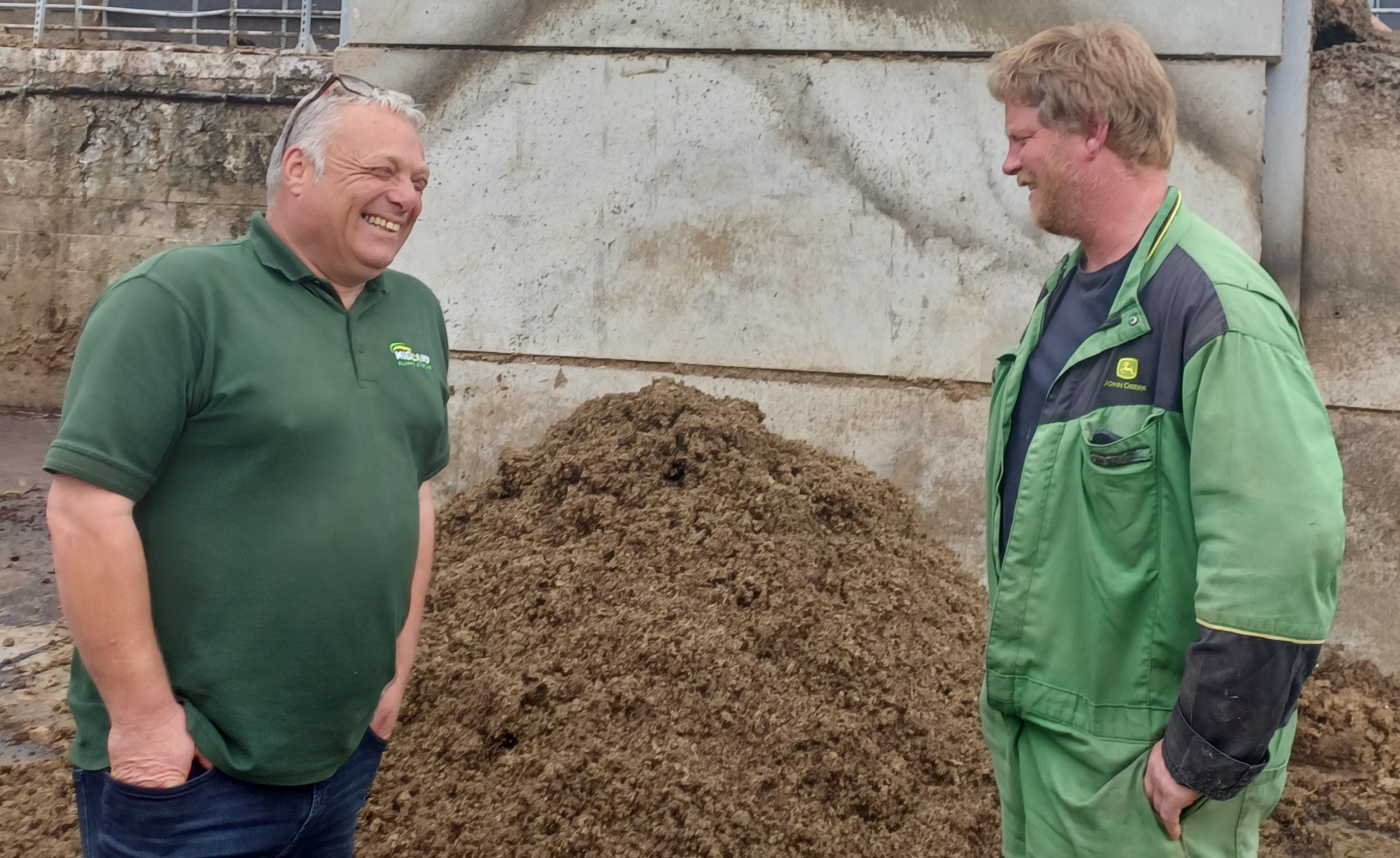
A new separator, pump and mixer have greatly improved slurry handling at a popular village-based dairy farm in Warwickshire.
Slurry from 105 Holsteins had become an ongoing challenge at Chesterton House Farm in Harbury, near Royal Leamington Spa, with it typically being too runny to put into spreaders and too thick to pump.
George Clarke who is in a business partnership with Louise Trice who owns the farm, said:
“To be fair, what we had before was just a pit that all the scrapings and everything went into, so it was a mess. We could see the compaction in the fields (200 acres) at silage time, with all the wheel marks from the spreader, where the grass hadn’t grown as it should have.”
George contacted Midland Slurry Systems of nearby Shipston-on-Stour, who have been working with Chesterton House Farm since before 40-year-old George was born.
He added: “Seeing big puddles being made everywhere from the spreader wasn’t good at all, so as part of us wanting to keep the farm moving forward, we knew it was time to make changes.”
Looking for a simple, cost-effective system that would largely take care of itself, George worked closely with Giles Russell at Midland Slurry Systems to introduce an EYS separator to mechanically separate the solid and liquid fractions of the fibre-rich slurry.
An integral part of the package also includes a 7.5kW Landia Chopper Pump to continuously reduce particle sizes as it transfers slurry up from the new 4m x 4m, 2m deep reception tank, that receives slurry through a new sewerage channel. The slurry (approximately 10% dry matter) in this vessel is kept fresh and homogenised by a 5.5kW Landia mixer. Installation, which was completed within three days, also included an ultrasonic level sensor for the reception tank, so that the new slurry system can work automatically, processing about 9m3 of slurry per day.
‘Good job of uniformly homogenising the slurry’
Giles Russell from Midland Slurry Systems, said:
“Because the Landia mixer does such a good job of uniformly homogenising the slurry, the fibre portion rides along the front of the auger and slides along the screen, keeping it clean. We’ve also developed a way of programming the separator, so that it is reversible, which prolongs its lifetime. We also know that Landia pumps and mixers will keep on running and running.”
George Clarke, who began working on the farm at weekends when aged 13, continued; “The only thing that will cause a problem is incidental solids that you get on any farm. So far, we’ve had a load of string, and when we got a bit keen trimming back our conifers, but overall, the whole system is very reliable indeed and frees up time. The Landia mixer kicks in first for a few minutes, getting a good swirl going to blend the slurry. Then the Landia Chopper Pump and the separator kick in. When it was wet last winter, the system would run every day, and now every three to four days when it is drier. Even if the slurry is reasonably thick, the system only needs to run for a couple of hours; less of course if it is thinner. And since we invested in 50kW of solar panels, it doesn’t cost a lot to run. Everything is very reliable, and if we ever need any advice or help, Midland Slurry Systems are always there for us.”
‘Noticeable improvement in grass growth’
Liquid slurry is pumped to the farm’s new 75m x 35m x 4.5m deep lagoon by a separate pump, whilst the dry matter from the separator is sent to a nearby arable farmer.
George Clarke added: “We expect to see a very noticeable improvement in grass growth for silage, and a reduction in the amount of bagged fertiliser we have to buy, which will be a big benefit.”
Each cow at Chesterton House Farm produces around 10,000 litres of milk pa, which goes to Arla, but the introduction of some vending machines has not only brought in some additional revenue, but at its location in the centre of the village, has shown many local people that the farm has a very valuable role to play. The success of the fresh milk from the vending machines (up to 1,000 litres sold per week) has seen George and Heather add a coffee machine, as well as sell products such as eggs, yoghurt and cakes at what has become a very popular hub and meeting place.
“It’s definitely improved our relationship with the village,” said George. “People now have much more of an idea of the work we do.”