
Previous editorials have highlighted the unwelcome effects of unbalance in rotating machinery. Basically, unbalanced machines require a lot of additional energy to run and at the same time cause damage to their bearings. This is because an unbalanced rotor results in a large RADIAL force that effectively crushes the bearings.
However, another equally damaging and power hungry machine fault is misalignment, such as could arise in couplings between pumps and their motors. This is because mislignment also results in large RADIAL forces that effectively crush the bearings.
Clearly, both unbalance and misalignment need to be avoided but how can they be detected?
As explained in previous editorials, a high level of vibration at the machine’s running speed is a good indication of unbalance. This is because in an unbalanced rotor the centre of gravity does not coincide with the centre of rotation. This results in the CofG acting as a “heavy spot” that produces a vibration as it spins around the centre of rotation. The more out of balance the rotor, the larger the resultant vibration.
In adition, a high level of vibration in a frequency band centred at TWICE the running speed is a good indication of misalignment. This is based on the fact that shaft misalignment usually results in double peaking in the waveform due to there now being TWO different centres of gravity (one from each shaft). In other words a vibration sensor (accelerometer) will detect a peak as each CofG passes by. Hence there will be TWO positive and TWO negative peaks for each revolution of the shaft. This typically results in a waveform shaped like M’s and W’s (as illustrated) giving a vibration signal at double the running speed of the machine.
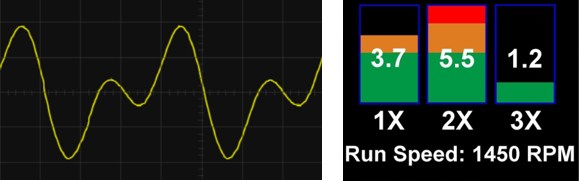
How misalignment might appear on the screen of a typical low cost, handheld vibration analyser, such as the TPI 9070, is shown in the screenshot alongside the waveform. In this example the presence of a high vibration of 5.5 mm/sec at 2X run speed is a good indication of misalignment. It is this ability to analyse vibration, so that its likely cause can be identified, that sets apart vibration analysers like the TPI 9070, from simple vibration meters.
So, having identified the existence of misalignment, what can we do about it? The answer is to re-align the coupling, typically by using shims under the mounting bolts. Fortunately, low-cost, easy to use precision alignment tools are now readily available, such as Easy-Laser’s XT series of laser alignment systems.
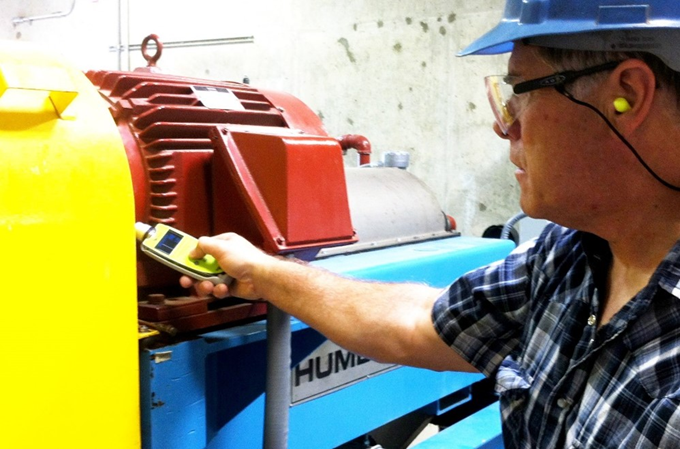
Test Products International (TPI) manufactures a complete range of low cost, high performance, and easy to use vibration analysis tools for maintenance engineers. All are incredibly easy to use, from the £570 one-button-to-press, TPI 9070 (illustrated) to state-of-the-art units that include easy to use rotor balancing.
For more information, please contact TPI Europe on +44 1293 530196 or www.tpieurope.com or email This email address is being protected from spambots. You need JavaScript enabled to view it.