
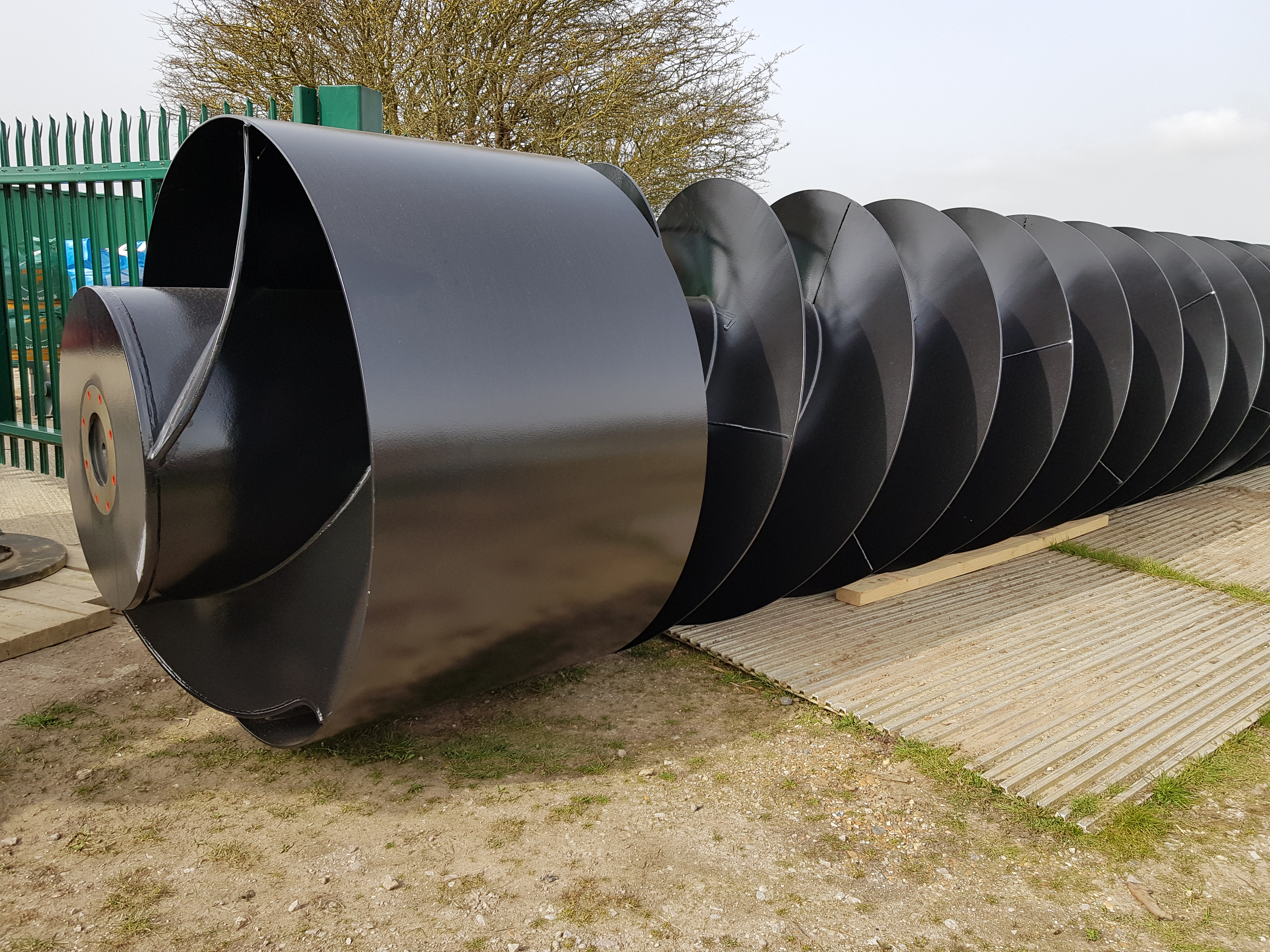
When the Environment Agency decided to embark on a project to evaluate a range of condition monitoring technologies for application on their flood risk management pumping stations, they approached Faraday Predictive as one of the more innovative of condition monitoring suppliers.
Within only a few days of commissioning the Faraday Predictive system on a number of different types of pump at different locations, the Faraday Predictive system showed some very strong indications of rubbing friction on one of the newly (re-)installed Archimedean Screw pumps at one site (figure 1 shows the screw prior to installation in the pump). It was clear this problem had been present at the commissioning stage, but was completely absent on an identical machine at the same site – see figure 2 below.
Such a rapid identification and diagnosis of problems was unexpected, but the underlying cause, of assembly error, highlights one of the problems and paradoxes associated with conventional fixed-schedule Planned Maintenance (PM): every time you carry out maintenance work on a machine, you run the risk of introducing a fault that was not there before. So perversely, the more you maintain a machine, the greater your risk of reducing its reliability. The ideal objective is only to do maintenance work on a machine when you know that there is a problem developing, but before it results in machine failure. This is the key concept of a Condition-Based Maintenance strategy (CBM).
The Faraday Predictive MBVI (Model-Based Voltage and Current) system has been conceived specifically to help in the adoption of CBM, by giving coverage over the widest possible range of probable failure modes. It monitors the behaviour of the entire machine (motor + transmission + driven equipment + process in some cases) just by measuring the voltage and current drawn by the motor. This includes identifying and diagnosing faults of mechanical and operational nature as well as electrical faults and energy wastage.
In this case, the system auto-diagnosed the huge peaks visible at the left-hand side of the upper spectrum in figure 2 as all corresponding to rubbing friction at motor shaft speed, with the most likely cause being rubbing on the motor pulley. For three days the two pumps continued to reflect these very different profiles. Then a correction was made, and the problem disappeared. The two pumps’ profiles are now virtually identical.
This illustrates how the Model-Based approach effectively amplifies the non-linear behaviour that is a common feature of faults, making them highly visible – and all of this just from measuring voltage and current.
With climate change becoming an ever more present reality, the focus on flood risk management has been increasing over recent years. The Environment Agency (EA) is responsible for a large number of pumping stations right across England, with a wide range of different types of machine including submersible pumps, Archimedean screw pumps, flood gates, screens etc. The pressure to improve the reliable performance of these assets is combined with the inevitable budgetary constraints - and hence the need to adopt ever more efficient and effective approaches.
Keith Solts, Asset Standards and MEICA Engineering Manager at the EA, has long believed in the value of Condition-Based Maintenance, and is the driving force behind the project.
The EA are keen to share the results of their findings as widely as possible, and are already embarked on a programme of public conferences and presentations, which has already started with a presentation in early December to a Civil Engineering Tech Fest. Other presentations are planned for the course of 2022. Keep your eyes open for the latest updates.
For any questions about the MBVI technology EA are using, contact This email address is being protected from spambots. You need JavaScript enabled to view it., 0333 772 0748.