
The “Model” in Model-Based Voltage and Current (MBVI) systems is a mathematical one
Sophisticated Condition Monitoring systems that can automatically diagnose incipient faults in your machines, are made possible by some clever mathematics that take complex machine signals and translate them into readily understandable information. In the best systems, such as the MBVI systems from Faraday Predictive, these reduce all the complex data into the form of simple, actionable advice:
- this is what is wrong with your machine
- this is what you should do about it
- this is the time you have available to do it
These systems encapsulate generations of engineers’ experience of the problems machines can suffer, the symptoms machines display when suffering from those problems, and the best ways to deal with those problems. In these days of skills shortages and ageing population profiles, this captured experience can be invaluable to ensure long term business sustainability.
Modern Mathematicians, building on the foundations started over two centuries ago, are now developing new understandings for the 21st Century, to create even more powerful fault diagnostic systems.
Vibration Monitoring systems base their diagnostics on the science of rotor dynamics – an understanding of how rotating shafts behave under the influence of forces at different frequencies, which can for example lead to resonant behaviour at critical speeds on some machines.
The fundamental calculation of resonant frequencies and other rotor behaviour is based on a mathematical model called the Jeffcott rotor, named after Henry Homan Jeffcott, an Irish engineer who developed the theory of rotor dynamics during the first world war, publishing his framework for lateral vibration in the Philosophical Magazine in 1919. This still forms a key building block for the understanding of rotating machine behaviour to this day, over a century later.
Electrical Machine analysis, such as MCSA, is based on a number of models created by engineers such as Charles Steinmetz, working at a similar time to Jeffcott, who created the Steinmetz Equivalent Circuit for representing the working of electric induction motors. Working even longer ago, in the 1830s Sir Michael Faraday’s law of induction predicts how a magnetic field will interact with an electric circuit to produce an electromotive force (EMF)—a phenomenon fundamental to the operation of electric motors and generators. This was built on in the 1860s by James Clerk Maxwell to create the mathematical formula – the Maxwell-Faraday equation - that is at the heart of our modern day understanding of the behaviour of electrical machines.
Faraday Predictive are now moving this field on further, working with a group of the top mathematicians in the UK, drawn from the universities of Cambridge, Oxford, Bristol, Durham, Leeds and others, to combine the best mathematical understanding of the electrical behaviour of machines with the best mathematical understanding of rotor dynamics, to create an integrated model of the behaviour of complete machines – eg electric motor plus transmission plus driven equipment carrying out a process. This enables diagnostics of the entire machine train just by measuring the voltage and current drawn by the motor.
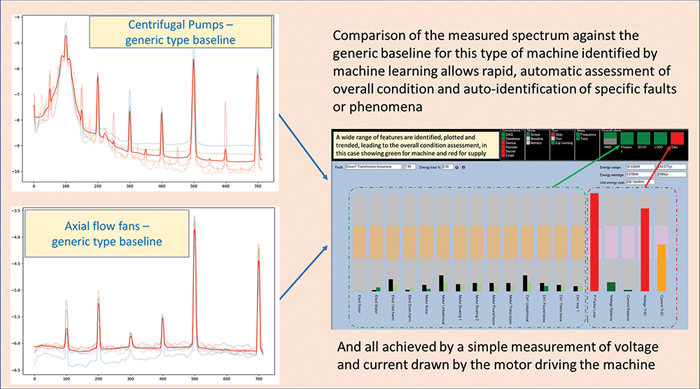
Different types of machines exhibit different characteristic behaviours, and more mathematics, in the form of machine learning, is used to identify how an individual machine’s behaviour compares with what would be expected for this type of machine, as shown in the spectrum diagrams. So a single reading of the voltage and current being drawn by the machine can identify areas of abnormal behaviour and provide advice on how to deal with it. This could be very specific such as identifying higher levels of flow turbulence inside a pump or incorrect tension on a belt drive – a whole range of specific features are identified and trended for each machine as shown in the bar graph.
For a demonstration of this system and what it could tell you about your own machines, contact Faraday Predictive – This email address is being protected from spambots. You need JavaScript enabled to view it., or call 0333 772 0748