
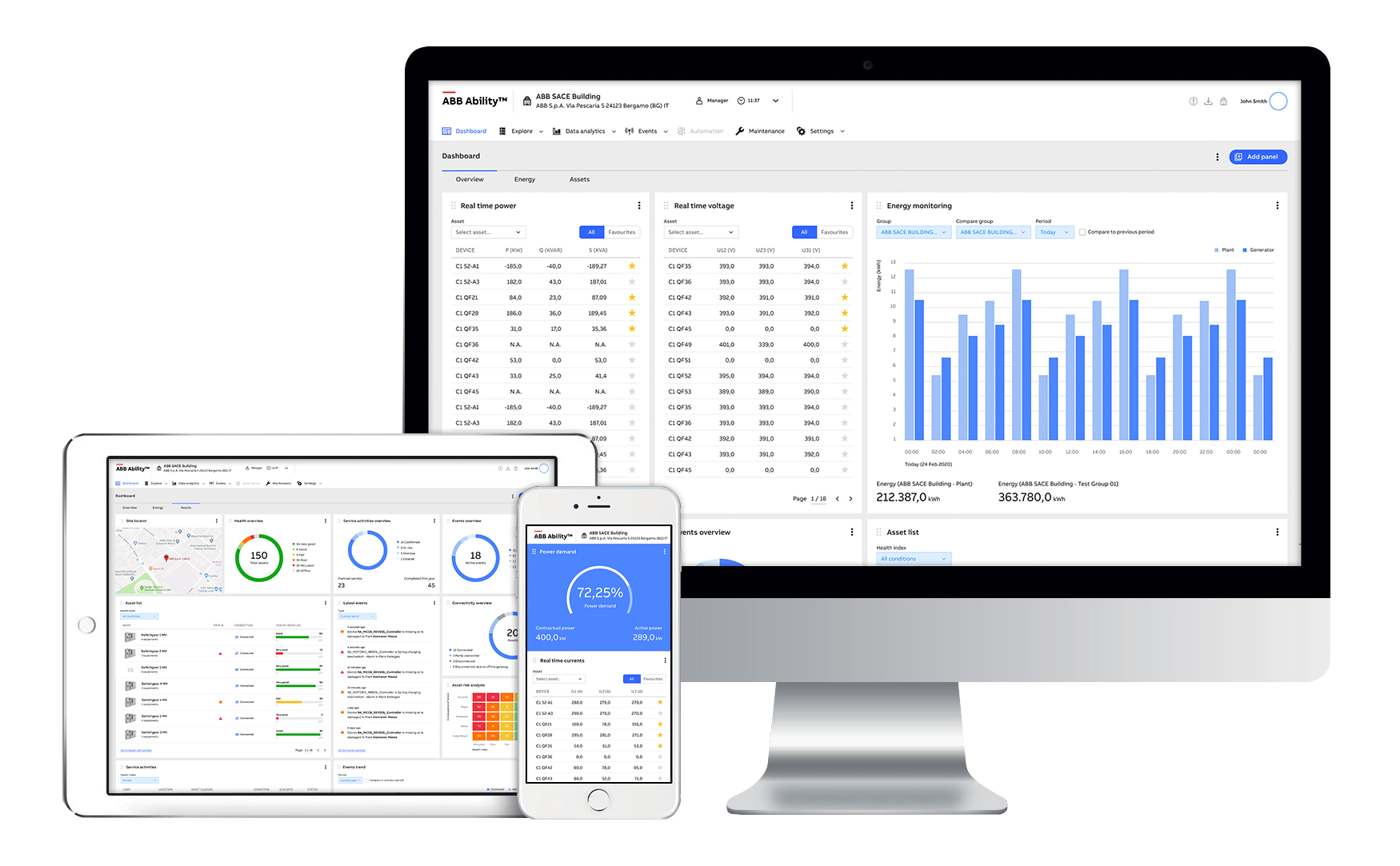
The industrial sector is evolving away from a linear economy, in favor of circular economy systems that improve resource efficiency, drastically reduce carbon emissions and deliver substantial cost savings.
One way to lower material dependency and avoid carbon emissions in the industrial supply chain is to improve asset management through digitalized, predictive maintenance.
Here, Alessandro Bottarelli, Business Sustainability Leader for ABB Smart Power Division, explores how predictive maintenance can promote circular economy.
A circular economy is based on the principles of designing out waste and pollution, keeping products and materials in use for as long as possible and regenerating natural systems.
It is no secret that predictive maintenance saves money, so adopting circularity is simply the next step for organizations wanting to preserve the environment, reduce carbon expenditure and keep spending down.
Carbon emissions in the supply chain
Every product and system used within an industrial environment has a ‘product carbon footprint’, which is accumulated at every stage, from cradle-to-grave.
It starts with the extraction of resources, such as metals, through to manufacturing of components and production of the final product, to transportation by land, air, or sea, plus emissions created during the use phase due to the product’s intrinsic power losses and finishes with the associated carbon cost of end-of-life disposal.
It makes sense therefore, that by expanding the usable life of the system through quality predictive maintenance, the extraction of natural resources and carbon emissions from manufacturing and production processes, as well as the upstream and downstream transportation emissions, will be avoided.
Condition monitoring to minimize maintenance
The concept of using predictive maintenance to extend asset life and reduce the impact of industry on the environment can be further improved with the introduction of condition monitoring.
For example, imagine a system has sensors installed to monitor the temperature around a critical internal component. Predictive maintenance processes will tell the asset operative that the temperature is too high, and the component is heading towards failure. This gives the operative time to source, purchase and install the replacement before failure occurs.
Condition monitoring takes this a step further, and allows the ongoing, real-time monitoring of system variables like temperature in finer detail. By using this method of system analytics, the operative will see the temperature slowly increasing in time and will be able to take corrective actions and avoid component failure. In doing so, they have prevented the need to buy a new component, reducing their resource dependency and eliminating the need for component production, transportation, and end-of-life disposal.
Maintaining a system in this more holistic way saves money on unnecessary repairs, reduces downtime and keeps maintenance labor costs minimal – cost savings that can all be attributed to using circular economy principles within an industrial environment.
Replacing outdated components
When it comes to maintaining systems that contain multiple complex components, such as switchgear for example, it is now possible thanks to leading manufacturers like ABB, to replace only the components that have become outdated.
Taking the example of switchgear, asset operators are able to replace outdated circuit breakers using specially designed retrofitting solutions, without scrapping the rest of their switchgear system.
In doing so, asset owners are able to keep much of their equipment in service, including the parts most damaging to natural resources, such as the metal cabinet, steel plates and busbars.
Retrofitting just the outdated component dramatically reduces the carbon emissions required to return the switchgear system to service, saving money and promoting circularity.
Upgrading technologies without upgrading systems
Industry 4.0 and IoT connectivity are key drivers for system upgrade programs and businesses are investing heavily in automation – cutting short the service life of many systems that are no longer compatible with future business objectives.
Only retrofitting parts of a system that deliver connectivity and advanced functionality instead of decommissioning and replacing entire systems is a far more cost-effective solution. It enables much of the equipment to remain in service, only requiring the production, transportation and end-of-life disposal of critical upgraded components.
Retrofitting options to upgrade technology can not only help organizations to work towards a more circular economy but can also deliver significant cost savings compared to replacing entire systems.
For more information on how ABB is supporting its customers in achieving circularity through data-driven asset management, click here.