
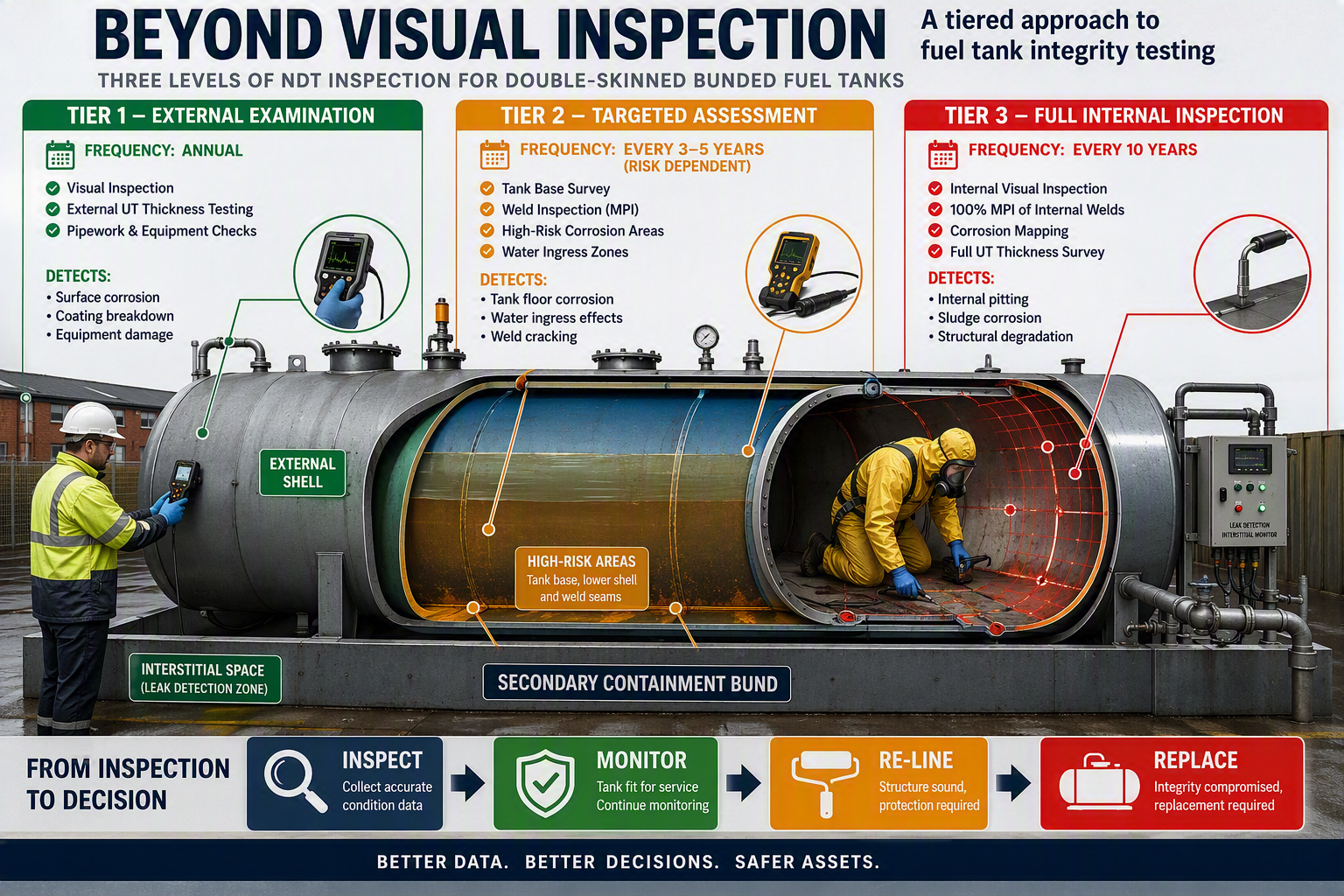
Standby power, fleet depots, marine terminals, industrial plant: different applications, the same testing problem.
Visual inspection has its limits. While it can identify obvious signs of deterioration such as coating breakdown, surface corrosion and staining, it cannot determine remaining wall thickness, weld integrity or the condition of internal surfaces. For many fuel tanks these hidden factors often represent the greatest risk.
This is where Non-Destructive Testing (NDT) provides value. Rather than relying solely on a visual inspection that cannot look deeper than the surface, NDT delivers measurable condition data that supports informed engineering decisions regarding maintenance, repair or replacement.
Tier 1: External Examination
Recommended annually for tanks.
This first level combines:
- Visual inspection of the tank external surfaces
- Ultrasonic Thickness (UT) measurements of the external surfaces
- Inspection of ancillary equipment, including pipework, vents, gauges and alarms
The objective is to establish a baseline condition assessment and identify potential areas of concern without interrupting normal tank operation.
Typically identifies:
- Surface corrosion
- Coating failure
- Equipment deterioration
- External metal loss
Tier 2: Targeted Assessment
Additional to Tier 1, a targeted inspection of known or suspected problem areas.
This level further enhances Tier 1 findings and focuses on locations commonly associated with accelerated deterioration, including:
- Lower shell sections
- Areas subject to increased external corrosion
- Accessible weld seams
Inspection techniques include:
- Detailed UT surveys
- Magnetic Particle Inspection (MPI) of welds
Typically identifies:
- Tank corrosion
- Localised thinning
- Weld cracking and defects
Tier 3: Full Internal Inspection
Tier 3 is the most comprehensive assessment available, encompassing Tiers 1 and 2, with the addition of the following inspection activities:
- Full internal visual inspection
- 100% MPI of internal welds
- Internal UT thickness testing
- Corrosion mapping
In order to carry out these inspections the tank must be:
- Taken out of service
- Cleaned internally
- Prepared for inspection
- Managed under confined-space procedures
This level provides a complete understanding of the tank's internal structural condition and potential remaining service life.
Additionally identifies:
- Internal pitting and corrosion
- Localised thinning
- Sub-surface defects within the welds
- Structural deterioration
- Weld cracking and defects
From Inspection to Asset Management
The true value of NDT lies not in a single inspection report, but in the ability to build a condition history over time.
Successive inspections provide evidence of:
- Corrosion progression rates and patterns
- Identification of any potential failure points
- Future maintenance requirements
- Remaining asset life
This data enables asset owners to make informed decisions rather than reactive ones.
Recommended Decision Path
Inspect → Monitor → Repair → Replace
Inspect - Regular visual inspections
Monitor – Identify and track problem areas
Repair – Carry out remedial works to restore integrity
Replace - Structural condition no longer supports continued operation or economic repair
Specification Matters
Where replacement is necessary, specification is critical.
OTS manufactures fully enclosed bunded steel fuel tanks designed and constructed to BS 799-5:2010, the recognised industry standard for steel oil storage tanks. In addition, OTS are also certified to manufacture to OFTEC OFS T200, which verifies the integrity and performance of the complete bunded tank system, providing clients with enhanced confidence in compliance, quality and environmental protection.
NDT is more than a compliance exercise. It provides the evidence required to manage risk, extend asset life where appropriate, and make informed decisions on repair, refurbishment or replacement before failure becomes a business, environmental or safety issue.
Better data. Better decisions. Safer assets.
For fuel tank NDT inspections or further information, contact OTS Group on 01386 853409 or visit otsgroup.co.uk.