
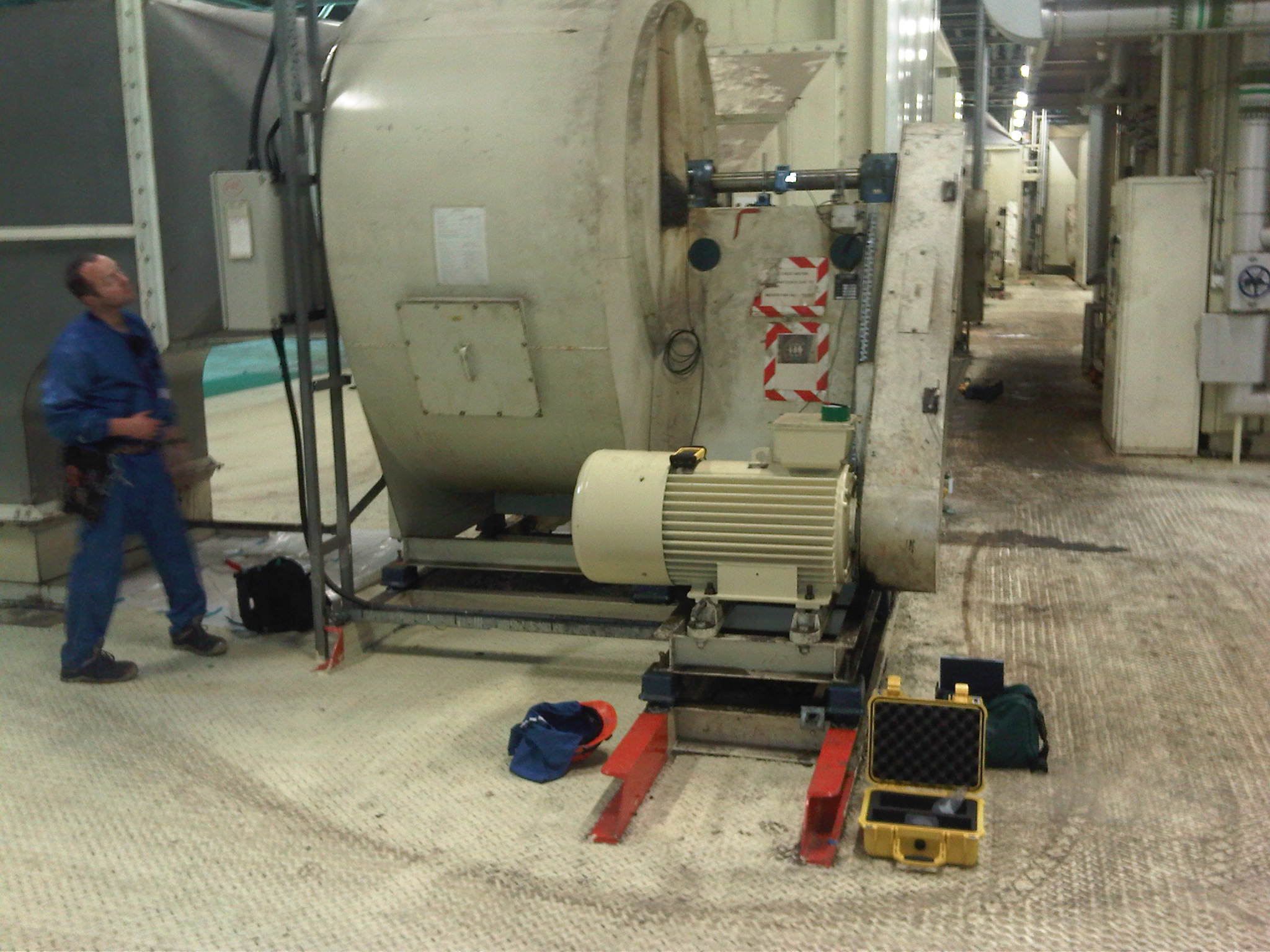
We all know what happens to a spin drier with unevenly distributed washing (i.e. an unbalanced load). It will vibrate, which often results in the spin drier jumping all over the place! Let’s think about that for a minute. To bounce around a 70kg washing machine requires quite a bit of effort (i.e. force) and all that force has to go through the bearings! They’re not going to like it!
Imagine the situation where the machine is running 24/7, as with an exhaust fan or a continuous process pump for example. It won’t take long before you’re replacing those bearings! But it’s even worse than you think. To bounce around that unbalanced washing machine also requires a lot of energy, in other words it requires more electricity. So, by running machines even slightly out of balance, not only are you unnecessarily wearing out your bearings faster, you are also paying extra for the privilege!
But how do you know when a machine is unbalanced? Well, in theory a perfectly balanced machine would not vibrate. But in practice there is no such thing, so all machines vibrate. The more unbalance, the more vibration and bearing damage. Fortunately, the International Standards Organisation (ISO) has drawn up a set of guidelines for acceptable levels of machine vibration. Modern low-cost vibration analysers like the TPI 9070 (pictured) are available, pre-programmed with the ISO levels, to give a traffic light system of colour coded vibration readings. Basically, if it’s in the red it needs balancing!
There are two techniques commonly employed in balancing. The no-phase balancing technique (a.k.a. the 4-run method) allows you to approximately balance a machine by using a series of four runs, three of them with a trial weight attached to the rotor. By positioning the trial weight around the rotor’s circumference in 120 degree increments and measuring the resulting vibration, the balancer automatically calculates the location and magnitude of the “heavy spot” around the 360 degrees of the rotor‘s circumference. It also then calculates what weight, and at what position, will re-balance the motor, pump or fan. This is then done either by adding the weight to the rotor at a position opposite the heavy spot or easier still, by drilling holes to remove the equivalent weight at the heavy spot.
The 4-run method works well enough for cases where an approximated balance is all that is required. However, for larger machines that require more precise balancing or for dual-plane balancing (e.g. for longer rotors that need to be simultaneously balanced at both ends) we generally require more precise measurement of the unbalance. This is done by providing a reference position on the rotor’s circumference, known as a “key-phasor” input. Often this can easily be obtained from the machine’s tacho signal or alternatively, simply by affixing a piece of reflective tape to the rotor and using a low-cost laser tacho to give a reference pulse, once per revolution. This reference pulse is then used by the balancing software to accurately determine the location of the “heavy spot” around the 360 degrees of rotor circumference and calculate precisely how to counterbalance it.
It doesn’t take very much to unbalance a machine, e.g. dirt build-up on fan blades or a chipped pump impeller. Thankfully, it also doesn’t take much to re-balance it either, provided you have the right instrument. These days that’s not a problem, as simple to use, low-cost field balancers are now available that take you through the process on an easily followed step-by-step basis. For example, TPI’s Ultra III vibration analyser is now available with both built-in no-phase and single/dual plane key-phasor balancing. For the latter, the included laser tacho (TPI 505L) can be used by the Ultra III to calculate precisely what is required to re-balance the motor, pump or fan.
For more information, please contact TPI Europe on +44 1293 530196 or www.tpieurope.com or email This email address is being protected from spambots. You need JavaScript enabled to view it.