
Power transmission networks are under growing pressure. Operators must maintain ageing infrastructure, respond to increasing electricity demand and support grid modernisation and expansion, all while protecting the people who inspect, maintain and upgrade thousands of towers.
At the same time, an ageing workforce and shortage of experienced workers are increasing the need for safe, consistent working practices across employees and contractors. Yet while investment often focuses on electrical capacity and structural integrity, tower access can receive less attention. Structures may remain operational for decades, while the methods used to climb them may no longer reflect the practical needs of today’s workforce.
In some cases, towers may still rely on climbing methods based around repeated double-lanyard transitions, even as the wider network around them is being modernised. Fall protection retrofit should therefore be viewed not simply as an equipment upgrade, but as part of a wider asset integrity and risk management strategy.
The risks within existing assets
Transmission networks rarely consist of uniform structures. They often include several generations of towers with different heights, geometries, climbing routes and access arrangements. Some may have permanent fall protection systems, while others rely on double-hook lanyards, individual anchorage points or older equipment. The presence of fall protection equipment does not necessarily mean it remains suitable.
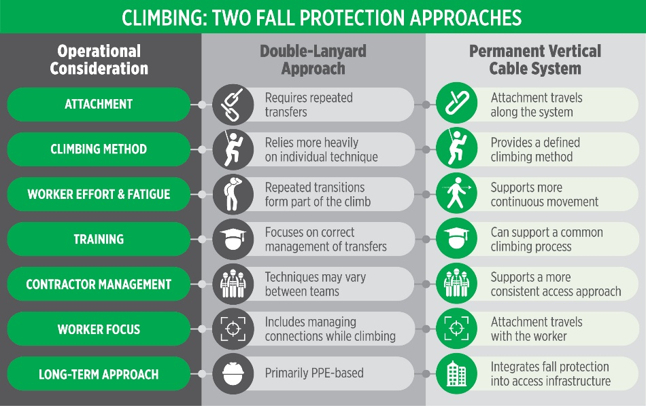
Components may deteriorate, replacement parts can become difficult to source, and older systems may no longer provide the usability expected by modern climbing teams. Traditional double-lanyard methods also require workers to repeatedly disconnect and reconnect while climbing. This can increase physical effort and create opportunities for inconsistent technique, snagging, entanglement or excess slack.
The distinction is therefore not simply between different pieces of equipment, but between a method that relies on repeated worker actions and one where fall protection is integrated into the access route.
Creating consistency across the network
Consistency is a significant challenge for transmission operators managing thousands of structures and a mixture of employees, contractors and subcontractors. Workers may encounter several access systems within the same programme of work, each with different equipment and connection processes. This can add complexity to training, supervision and competence management.
A more standardised fall protection philosophy can help reduce that variation. This does not mean every installation must be identical. Transmission towers may be too varied for a one-size-fits-all approach. Instead, operators can establish a consistent method of protection that is engineered around each structure.
Flexible vertical lifelines can support this. Cable routes, brackets and attachment arrangements can be adapted to individual towers while allowing workers to use the same fundamental climbing method and personal attachment device.
Adapting to existing infrastructure
Retrofit also needs to account for the physical diversity of transmission towers. Climbing routes may change direction, pass around projecting steelwork or follow tapered tower legs, while ladders and access points may not follow a perfectly vertical route.
MSA’s Latchways® vertical lifeline systems can be engineered to follow different tower contours, with intermediate brackets used to guide the cable around changes in direction. Designed for both new and retrofit applications, the systems can be configured around different tower shapes and climbing geometries. They can also make use of existing tower step bolts, ladder rungs or suitable structural connections, helping to limit intrusive alterations. Every installation must still be individually assessed and engineered.
Building retrofit into wider programmes
Operational disruption is another important consideration. Access upgrades may need to take place during planned maintenance windows or alongside wider grid modernisation and refurbishment programmes.
A phased approach can make retrofit more manageable. Operators may prioritise frequently climbed towers, structures already scheduled for refurbishment, assets without permanent fall protection or locations where existing access methods present the greatest concern.
Cost can be considered over the life of the system, rather than through purchase price alone. Service life, inspection requirements, installation time, component availability, maintenance and the operational impact of future repairs can all influence long-term value.
MSA’s Latchways® vertical cable system uses corrosion-resistant stainless-steel components and incorporates an energy-absorbing mechanism designed to manage forces transferred to the user, anchor point and structure in the event of a fall.
A proactive approach to safer access
Waiting until fall protection equipment fails or becomes obsolete leaves operators responding asset by asset. A structured retrofit programme offers the opportunity to take a more proactive approach. That could begin by reviewing where legacy climbing methods remain in use, where access arrangements vary across the network and where permanent fall protection could be incorporated into upcoming maintenance, refurbishment or transmission expansion projects.
Ageing transmission infrastructure may continue serving the network for decades. But as the network evolves, the systems used to protect the people maintaining it should evolve too. Assessing tower access as part of a wider modernisation strategy can help operators identify retrofit priorities and establish a more consistent long-term approach to working at height.
To learn more about MSA’s Latchways® vertical lifeline systems and how they can support new and retrofit tower applications, visit www.msasafety.com