
Rotational moulding – Process Heating Matches New Opportunities
 The design opportunities that are arising from developments in plastic rotational moulding techniques signal a step forward for one of the more ‘traditional’ manufacturing processes.
The industry is now looking to take full advantage of new raw material options and enhanced equipment designs – a scenario in which Lanemark gas process burner systems have much to offer.
This progress – perhaps seen best where high strength and durability of rotational moulded products is required – is closely linked to the provision of efficient process heating, and Lanemark International can point to a growing list of customers in the sector who are gaining from the company’s forced draught (FD) gas burner technology.
As new production opportunities are reflected in the need for high quality processing techniques, the design and operating characteristics of
Lanemark burners are continually being refined to meet the challenge. Suppliers of both new and refurbished rotational moulding ovens will point to the efficient heating of plastic polymer granules contained within a steel mould, and their optimised transition then through liquid to gel, as being fundamental.
This is increasingly significant as these new opportunities gather pace – typified by the need to ensure the consistency and wall thickness of the resultant product meets the specified objectives. It is in this context that the excellent controllability and turndown capability of burner systems becomes so important – requirements fully met by Lanemark equipment.
The quality and consistency of the end product is as vital in this sector as any other area of manufacturing – especially in an increasingly competitive environment.
The case studies highlighted below offer an insight into how two leading companies in the industry are gaining from Lanemark’s track record and expertise.
Sorcerer Machinery/ XJF Plastics
Sorcerer Machinery’s advanced polymer coating technology is behind the development of a range of machines in the sector. The company highlights a typical installation of four units at XJF Plastics in Chesterfield who design and manufacture rotational moulded components for customers in sectors ranging from construction to materials handling – particularly impressive is its range of marine navigation aids.
Traditionally, polyethylene materials are well recognized as being highly suitable for rotational moulding operations but their soft and flexible characteristics have inevitably limited them to certain types of design.
Now, new materials lend themselves to applications in perhaps more stress-sensitive areas or with a more complex design, such as the aerospace and marine sectors. This trend calls for high levels of temperature control to maintain powder flow requirements to meet objectives such as impact resistance, strength or resistance to deflection, and it is here that the capability of the Lanemark burner design is critical.
The Sorcerer Machinery equipment operated by XJF Plastics achieves a 200ฐC rise in temperature in just two and a half minutes, maintaining this level within 1ฐC. The two-axis rocking design allows the polymer material to form efficiently – enhanced by close links between the burner controls and the machine’s temperature control system.
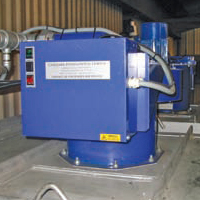
Benefiting from a Lanemark FD15 design, rated at 515 kW, firing directly into a burner combustion chamber, the application is seen as an excellent example of the use of the company’s burners in a rotational moulding context and the control and turndown advantages they offer.
www.lanemark.com
RotoMech Engineering
With an excellent track record in supplying both refurbished and new rotational moulding systems to industry, customers of RotoMech Engineering – both sub-contract moulders and in-house producers – call for flexible systems that are central to high quality end products. The optimum provision of process heat using Lanemark burner designs in this context, is seen as fundamental.
The use of Lanemark systems has helped RotoMech Engineering to develop a leading position in this sector, not least because of the controllability and the turndown characteristics of the burner design. The company makes full use of the capabilities of Lanemark’s expertise via packaged heating solutions that offer installation simplicity and ease of maintenance.
Operating on either natural gas or propane, the range of Lanemark forced draught ‘FD’ burner systems will typically heat a rotational moulding oven to approximately 300ฐC, and maintain this level to within +/– 5ฐC, to optimise material dispersion.
The turndown characteristics of the burners in this context is extremely important as it is not uncommon for the moulding oven to be kept ‘on hold’ pending the next mould being prepared and located.
RotoMech’s expertise is centred on both drop and straightarm systems, which provide the rotation and oscillation that the rotational moulding process is based upon. The FD burners are roof mounted on the moulding ovens and fire vertically down into the re-circulated process air flow delivering a clean and efficient h heat input into the system.
The application is seen as a good example of forced draught gas burner technology offering the optimum blend of performance, control and economic operation when compared to electrically heated alternatives – which can often be slow and relatively expensive – and radiant heating systems which are limited to simple shapes.
Lanemark House, Whitacre Road, Nuneaton, Warwickshire CV11 6BW United Kingdom
Tel: +44 (0) 24 7635 2000 Fax: +44 (0) 24 7634 1166 E-mail: This email address is being protected from spambots. You need JavaScript enabled to view it. www.lanemark.com

Explore EMS
More Editorial
Directory
This website is owned and operated by: MSL Media Limited

Co. Number: 05359182
© 2005 MSL Media Ltd. All rights reserved. E&OE