
Field-Applied Corrosion Protection in Waste-to-Energy Plants
Waste-to-Energy (WtE) and biomass plants operate in some of the most aggressive environments, with high-temperature corrosive gases, ash, and variable fuels that pose serious challenges to boiler reliability. Field-applied corrosion protection technologies have become reliable ways for plant operators to mitigate corrosion, reduce unplanned outages, and extend component lifespans.
This article outlines corrosion mechanisms common to WtE operations, evaluates key field-applied protection technologies, and presents a case study from a UK biomass plant that successfully applied engineered cladding to prevent boiler tube failures.
Corrosion Mechanisms in WtE Operations
Boiler components in WtE plants, especially waterwall tubes, superheaters, and economizers, are regularly exposed to corrosive gases containing chlorine, sulfur compounds, alkalis, and acidic vapors. Inconsistent fuel compositions and temperature fluctuations further accelerate corrosion and erosion processes. Components such as bull nose sections and fire-facing walls are particularly vulnerable.
Common degradation mechanisms in WtE boilers include:
- High-temperature corrosion from alkali salts and chlorine species
- Fly ash erosion from particulate in flue gases
- Stress corrosion cracking under wet ash or acidic condensation conditions
- Metal wastage from rapid oxidation and pitting
Protective solutions must withstand this multi-mechanism degradation while being quickly deployable during short maintenance windows.
Evaluating Field-Applied Protection Technologies
- Weld Overlay Cladding
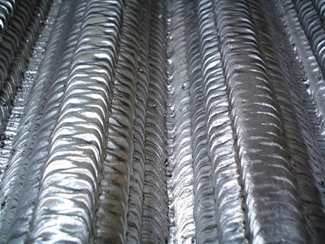
Weld overlay on boiler tubes
Overview
Weld overlay involves bonding a corrosion-resistant metal layer (e.g., Inconel) to the base metal through arc welding.
Pros:
- Metallurgically bonded and long-lasting
- Suitable for high-temperature zones
- Thick layer (3 mm+) provides erosion resistance
Cons:
- Slow application rates
- Causes heat-affected zones (HAZ) and distortion
- Requires post-weld heat treatment (PWHT)
- Not ideal for thin or already eroded tubes
2. High Velocity Thermal Spray (HVTS®)
Overview
HVTS accelerates fine metal particles at supersonic speeds to form dense, adherent coatings without thermal distortion.
Pros:
- Rapid application. 2–3x faster than weld overlay
- No HAZ or PWHT needed
- Excellent corrosion/erosion resistance in aggressive environments
- Suitable for in-situ application over large areas and complex geometries
- Customizable alloys for specific operating conditions. 15+ years lifespan.

HVTS Application
Cons:
- Mechanical (not metallurgical) bond
- Requires specialized equipment and expertise
- Maximum coating thickness typically 1 mm
3. Organic Epoxy Coatings
Overview
Epoxy novolacs applied at ambient temperature for lower-temperature service areas.
Pros:
- Low cost
- Fast application over large areas
- No heat input or thermal stress
Cons:
- Limited to <140°C applications
- Susceptible to thermal shock and moisture intrusion
- Shorter service life (2–5 years)
- Risk of pinholes, delamination, or underfilm corrosion
Case Study
Preventing Boiler Tube Failure at a UK Biomass Plant
A UK-based biomass power station faced significant corrosion and erosion across the boiler's waterwall tubes. Non-destructive testing (NDT) revealed extensive thinning in the front and rear walls, sidewalls, bull nose, and horizontal passes.
Left unaddressed, could have led to:
- Emergency outages
- Expensive reactive maintenance
- Lost generation revenue
- Safety hazards and potential equipment damage
Solution Evaluation
Two options were assessed:
- Weld Overlay - Proven and durable but slow, high-heat, and disruptive
- HVTS® Cladding - Faster, lower heat input, and customizable alloy for biomass flue gas environments
Given time and risk constraints, the team selected HVTS, building on successful smaller applications in 2023.
Implementation
Scope:
Protecting 168.7 m² of boiler surface during a 6-day February 2025 outage.
Timeline:
- Feb 3: Mobilization and setup
- Feb 4–7: Blasting and HVTS application (day/night shifts)
- Feb 7 (night): Topcoat applied
- Feb 8: Demobilization
Ventilation was maintained with an induced draft (ID) fan to ensure application quality and safety.
Results
- On-time Completion
Entire application completed within the planned outage window
- Thorough Coverage
All critical areas identified by NDT were successfully protected
- QA Compliance
Post-application inspections verified thickness and uniformity
- Improved Longevity
The coating is expected to significantly extend tube life (15+ years)
- Cost Savings
£100,000–£120,000 saved compared to weld overlay, due to shorter outage and lower direct costs
- ROI
Preventing emergency failures is projected to yield over 300% ROI in the first year alone
Selecting the Right Protection Strategy
Effective corrosion mitigation in WtE plants requires matching technology to the environment.
|
Feature |
HVTS |
Weld Overlay |
Epoxy Coating |
|
Application Speed |
Fast |
Slow |
Fast (but curing time) |
|
Heat Input |
Low (no distortion) |
High (risk of HAZ) |
None |
|
Temperature Resistance |
>500°C |
>500°C |
<140°C |
|
Service Life |
10–15+ years |
10+ years |
2–5 years |
|
Erosion Resistance |
Excellent |
Good |
Poor |
Conclusion
WtE plants must balance long-term durability with short outage windows and cost-efficiency. Technologies like HVTS® offer a modern solution, delivering high-performance protection, rapid deployment, and measurable cost savings. Applying a structured evaluation framework ensures that the correct mitigation method for your unique scenario is chosen, thereby enhancing reliability, safety, and profitability.
Integrated Global Services, IGS - Your Efficiency & Reliability Partner

Explore EMS
More Editorial
Directory
This website is owned and operated by: MSL Media Limited

Co. Number: 05359182
© 2005 MSL Media Ltd. All rights reserved. E&OE